Small businesses make cybersecurity decisions every day, whether they call them security decisions or not.
An employee shares a customer file with a coworker.
Someone downloads a new application.
A manager gives a new hire access to company systems.
A team member receives an unusual email asking them to reset a password.
An employee leaves the company and their accounts need to be closed.
Each decision creates an opportunity to protect the business, or to introduce unnecessary risk.
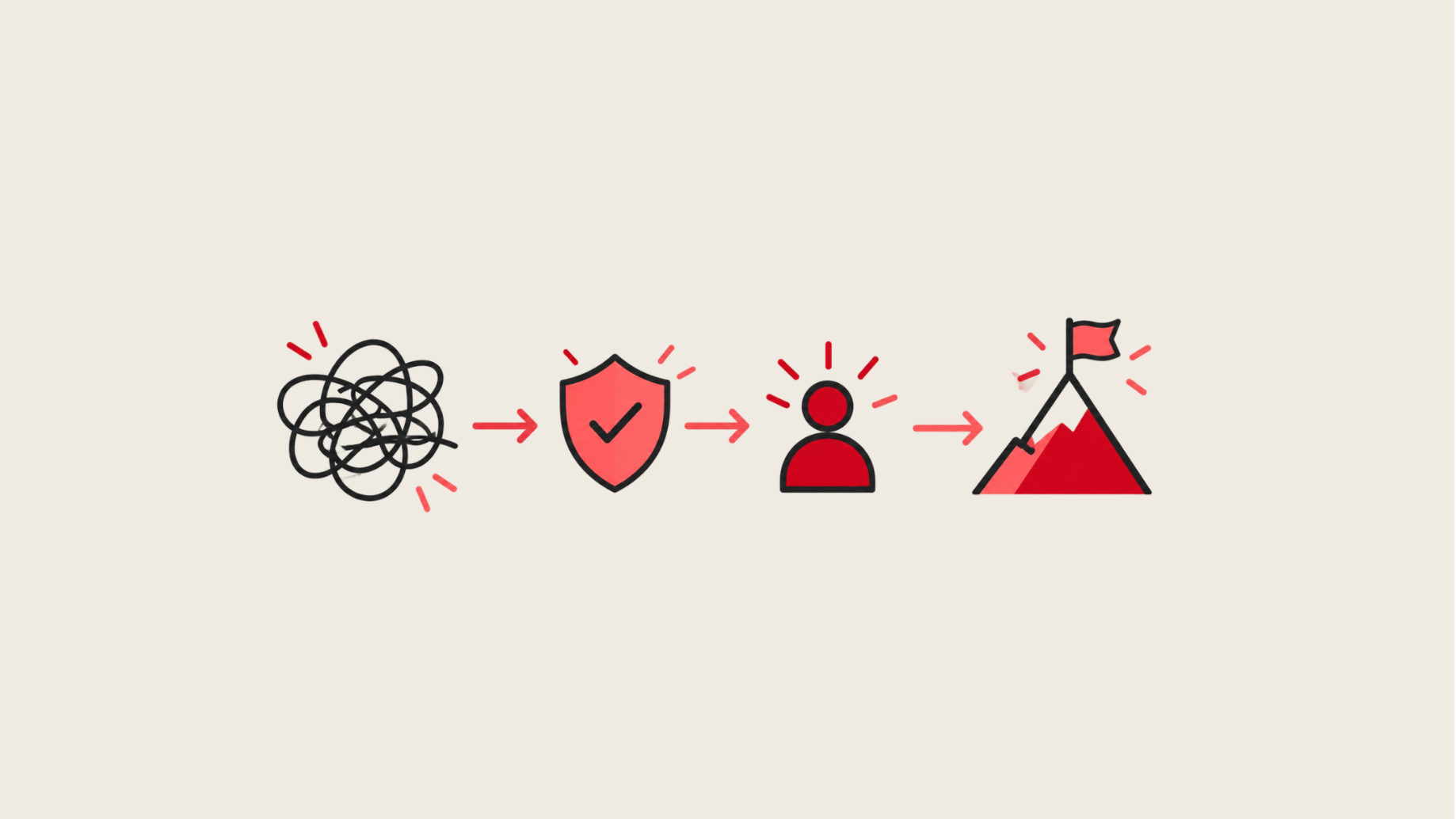
Everyday risk becomes much easier to manage when people understand what matters, what's expected of them, and what to do when they're unsure.
That's one of the biggest Information Security Policy benefits for a small business.
That doesn't mean small businesses should operate in fear of everything that could go wrong. Quite the opposite. Everyday risk becomes much easier to manage when people understand what matters, what's expected of them, and what to do when they're unsure.
That's one of the biggest Information Security Policy benefits for a small business.
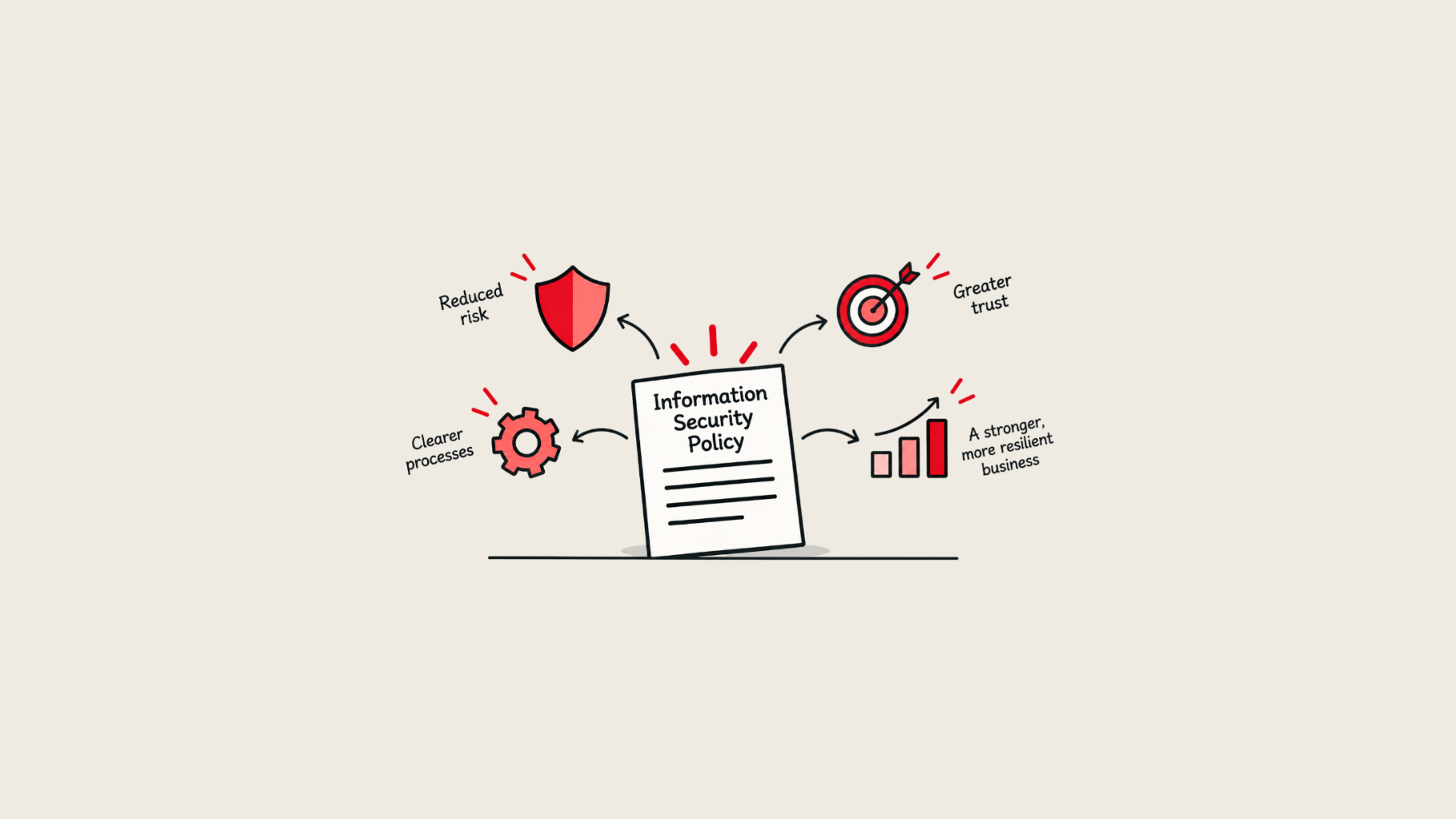
A good Information Security Policy creates shared expectations for protecting your company's information, systems, technology, and the data customers trust you to handle. It reduces uncertainty, helps employees make more consistent decisions, and gives your business a stronger foundation for growth.
And its value extends far beyond cybersecurity.
What are the benefits of an Information Security Policy?
The simplest way to think about an Information Security Policy is as the document that establishes how your organization expects information and technology to be protected.
But the document itself isn't the real value.
The value comes from what happens when those expectations have been not only documented, but also communicated and consistently put into practice.
The value comes from what happens when those expectations have been not only documented, but also communicated and consistently put into practice.
For a small business, the most important Information Security Policy benefits include:
Protecting business and customer information
Reducing everyday security and operational risks
Building customer trust
Creating more consistent decision-making
Giving employees greater confidence and autonomy
Identifying and prioritizing security improvements
Strengthening business resilience
Supporting growth and new opportunities
Let's look at what those benefits actually mean for a small business, your team, and your customers.
1. Protect the information you rely on
Every small business has something worth protecting.
Customer information. Employee records. Financial information. Intellectual property. Contracts. Email. Business systems. Relationships. Reputation. The knowledge and processes your team relies on to keep the business running.
An Information Security Policy helps protect those things by establishing clear expectations for how people interact with them.
Consider some very ordinary situations.
A former employee still has access to a cloud application because no one knew who was responsible for removing it.
A team member stores customer information in a personal cloud account because no one established where company files should be kept.
An employee downloads a new application without realizing the software will have access to company data.
Someone receives a suspicious email but doesn't report it because they aren't sure who to tell.
Two employees handle sensitive information differently because each has developed their own way of doing things.
None of these situations necessarily involves someone behaving irresponsibly. Often, people are simply making the best decision they can with the information they have.
A policy gives them better information to work with.
By establishing establishing expectations around access, authentication, data handling, devices, software, remote work, security awareness and training, and incident reporting, your business reduces the number of important security decisions that have to be made from scratch every time a new situation occurs.
Every business takes risks. Growing businesses have to.
The goal of an Information Security Policy isn't to eliminate every possible risk. It's to help your team understand which risks matter, create clear expectations for managing them, and make more consistent decisions when they arise.
When risk becomes clearer, better decisions become easier.
2. Build your customers' trust
Customers don't have to work inside your business to care about your security practices.
They may trust you with names and contact information, payment or financial information, confidential documents, account credentials, proprietary information, employee information, or access to their own systems.
When they hand that information over, they're also handing you some degree of trust.
A written Information Security Policy helps demonstrate that protecting that trust is intentional.
It shows that your business has thought about questions such as:
Who should have access to customer information?
Where should that information be stored?
How should it be shared?
What happens to access when an employee leaves?
What should someone do if they believe information has been exposed?
These expectations help turn security from something that exists primarily in people's heads into a repeatable business practice.
These expectations help turn security from something that exists primarily in people's heads into a repeatable business practice.
That's particularly important as your company grows.
Customers may begin asking security questions during procurement.
Prospective clients may send security questionnaires.
Partners may want to understand how you handle their information.
Cyber insurance applications may ask about your security practices.
Larger customers may expect documented policies before doing business with you.
A written policy doesn't automatically prove that a business is secure, and it shouldn't be treated that way.
What it can do is help demonstrate that your approach to protecting information is intentional, documented, and repeatable.
Customers don't necessarily expect a small business to have the resources of a global enterprise.
They can reasonably expect the business to take the information entrusted to it seriously.
Trust grows when your actions consistently support that expectation.
3. Ensure more consistent decisions
There's another common type of risk that's easy to overlook: inconsistency.
Imagine three employees receive the same unusual email.
One deletes it.
One clicks the link.
One forwards it to the owner and asks what to do.
Or imagine two managers onboarding new employees.
One gives the employee access only to the systems required for their role.
The other copies the permissions of the last person who joined the company.
Or two employees need to send a sensitive document to a customer. One uses an approved company platform while the other attaches it to a personal email.
The issue isn't necessarily that employees don't care about security.
They may simply have different ideas about what the right decision is.
Policies create a common starting point.
Consistency matters as a company grows because owners and managers can't personally oversee every decision forever.
Instead of relying on individual assumptions, experience, or convenience, your team has shared expectations to work from.
That consistency matters as a company grows because owners and managers can't personally oversee every decision forever.
And they shouldn't have to.
4. Give your team more confidence and autonomy
This is one of the most overlooked Information Security Policy benefits.
Good policies shouldn't create more bottlenecks.
They should reduce them.
Good policies shouldn't create more bottlenecks. They should reduce them.
Small businesses need people who can think, solve problems, and make decisions independently. If every security-related question has to be routed to an owner, manager, or single technical employee, the business becomes dependent on that person.
Clear policies distribute knowledge.
An employee doesn't need to ask where customer information should be stored if the expectation is already clear.
A manager doesn't have to invent an offboarding process every time someone leaves.
A team member who receives a suspicious message doesn't need to decide whether it's "serious enough" to mention if the policy clearly explains what should be reported and where.
The policy creates boundaries within which people can act confidently.
Clarity creates autonomy.
And autonomy encourages productivity.
Small businesses need people who can make good decisions without waiting for someone else to tell them what to do.
A strong Information Security Policy gives your team clear boundaries and expectations so they can act independently, make consistent decisions, and feel confident in their roles. Instead of relying on one person to hold all the answers, your business creates shared knowledge everyone can use.
That autonomy matters for resilience, too. When people understand how your business expects information to be protected, good decisions can continue even when a manager is unavailable, a key employee is out, or something unexpected occurs.
The goal isn't to control every decision. It's to give your team the clarity and confidence to make the right ones.
Here's something useful that can happen when you write an Information Security Policy:
You discover you're not doing everything you think you should be doing.
That's okay.
Maybe you decide multi-factor authentication should be required for an important system, only to discover it hasn't been enabled for everyone.
Maybe you establish that access should be removed promptly when someone leaves, but realize there's no consistent offboarding checklist.
Maybe your policy says employees should use approved applications, but no one has ever defined how software gets approved.
Those aren't reasons to abandon the policy-writing process.
They're reasons the process is valuable.
You have identified a gap betweenwhere your business is today and where you want it to be. In other words, you've found an opportunity toproactively improve your small business' cybersecurity posture.
Now you can decide how important that gap is, what needs to change, who should own the improvement, and when it should happen.
That's much more useful than copying a security requirement into a policy and pretending your organization already follows it.
This is where developing a Security Improvement Roadmap becomes especially valuable. Rather than trying to fix every gap immediately, your roadmap can help you prioritize improvements based on the risks that matter most to your business and make steady progress over time.
A gap isn't a failure.
It's information.
You don't need to fix everything at once.
Understand where you are. Decide where you need to go. Prioritize what matters most. Then keep moving forward.
Cybersecurity and business resilience are closely connected.
Think again about the small business where one person knows everything.
They know which applications employees should use.
They know who has access to what.
They know how customer information should be handled.
They know who to call if something unusual happens.
That can work remarkably well.
Until that person isn't available.
Policies help move important knowledge from individuals into the organization.
That doesn't mean documenting every decision your business could ever encounter. It means establishing enough shared knowledge that your team can continue making good decisions when circumstances change.
Policies help move important knowledge from individuals into the organization.
That becomes especially important during unexpected situations.
If an employee loses a laptop, does the team know what to do?
If someone suspects their account has been compromised, do they know who to contact?
If an important employee suddenly becomes unavailable, can someone else understand the expectations that guide their work?
If the business experiences a security incident, are employees starting from a shared understanding of their responsibilities?
Resilience comes, in large part, from reducing uncertainty before you need to.
Resilience comes, in large part, from reducing uncertainty before you need to.
And an Information Security Policy is only one piece of that foundation.
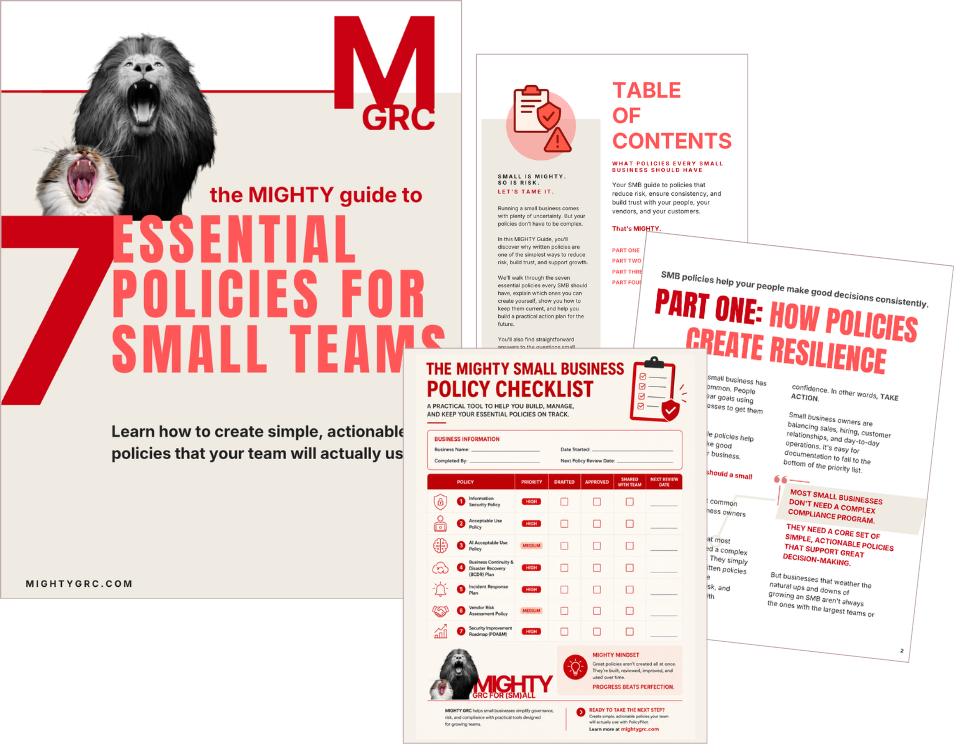
The MIGHTY Guide to 7 Essential Policies Every Small Business Needs explores how Information Security, Acceptable Use, AI Acceptable Use, Business Continuity and Disaster Recovery, Incident Response, Vendor Risk, and a Security Improvement Roadmap work together to help businesses reduce uncertainty and operate more consistently.
7. Scale, pivot, and grow your small business with confidence
There's an interesting shift that happens as small businesses grow.
Security can move from something happening mostly behind the scenes to something customers and partners actively ask about.
A larger prospective customer sends a security questionnaire.
A contract includes security requirements.
A partner wants to know how its information will be handled.
A cyber insurance renewal asks about documented practices.
A new employee needs to understand company expectations.
The business starts working with more vendors, more systems, more people, and more information.
Without documented expectations, answering those questions can become a scramble.
Someone has to figure out what the business currently does, determine who knows the answer, reconcile different practices, and then explain it.
A written Information Security Policy gives you a foundation of knowledge specific to your organization and team.
It doesn't guarantee that you'll meet every customer, contractual, insurance, or regulatory requirement. Different organizations will have different expectations.
But it does mean you're no longer starting from zero.
You've already begun answering an important question:
How does our business expect information to be protected?
That clarity can make it easier to identify what you already do well, where a prospective requirement differs from your current practices, and what you may need to improve next.
An InfoSec Policy is more than a security document
It's easy to think of an Information Security Policy as something you create because someone asks for it.
A customer wants to see one.
An insurance application mentions it.
A compliance requirement calls for it.
Those may be the reasons you finally sit down and write the policy.
But they aren't necessarily the biggest reasons to have one.
The real Information Security Policy benefits show up in how your business operates every day.
The real Information Security Policy benefits show up in how your business operates every day.
Clear expectations help protect company and customer information.
Shared guidance reduces inconsistent decisions.
Documented responsibilities reduce dependence on individual people.
Identifying gaps gives you a roadmap for improvement.
And repeatable security practices help demonstrate to customers that their trust matters to your business.
That's real business value for teams of any size.
Protect your business. Build customer trust.
Your Information Security Policy may be a security document, but its value extends far beyond cybersecurity.
It helps protect the information, systems, operations, and relationships your business depends on.
It gives your team the clarity to make better decisions independently and consistently.
It helps you identify risks and prioritize improvements.
And, it demonstrates to customers that protecting what they've entrusted to you is something your business takes seriously.
You don't need an enterprise-sized security program to start building that kind of confidence.
You need clear expectations, practical processes, and a commitment to keep improving.
Protecting your business and building customer trust aren't separate goals. They're both part of building a stronger, more resilient business.
Not sure where to start?
The Mighty Guide to SMB Policies
Get your free MIGHTY Guide to writing your first small business Information Security Policy, and take the first steps toward building a practical policy program that includes Acceptable Use, AI, Business Continuity, and more.
Start with an InfoSec Policy. Build a stronger business.
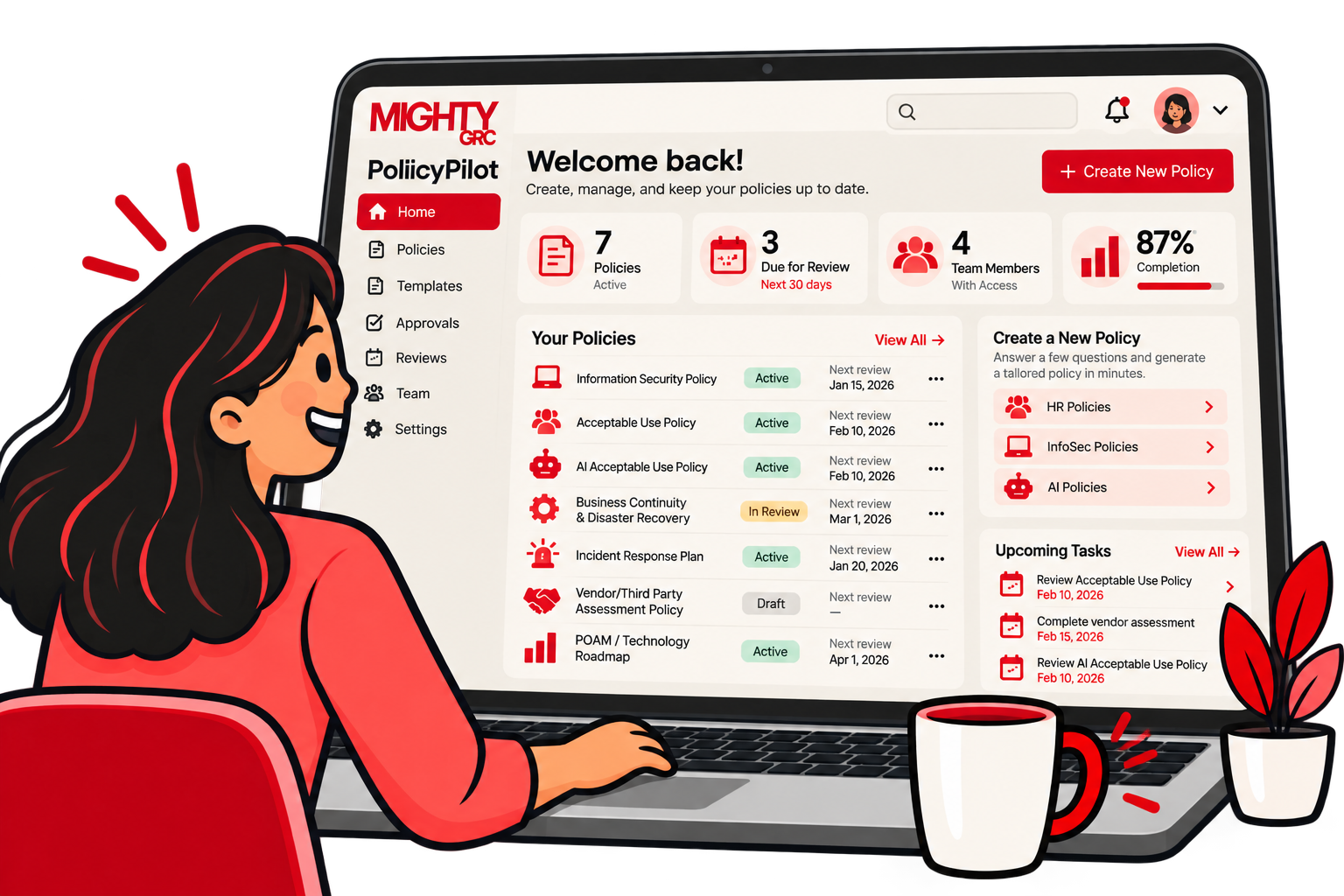
PolicyPilot by MIGHTY GRC helps small businesses turn complex policy requirements into clear, tailored policies built around how their business actually operates.
Creating an effective Information Security Policy shouldn't require weeks of research, a stack of generic templates, or an enterprise-sized compliance team.
Answer a few straightforward questions, and in minutes you can:
Customize your InfoSec Policy for your real world business.
Manage policy reviews and approvals in one place.
Use automated reminders to keep your InfoSec Policy current.
Because having a policy isn't the same as putting it to work.
Your policies should be simple. They should be actionable.
And they should actually get used.
Explore PolicyPilot today and start building your InfoSec Policy in minutes.
Thank you from the MIGHTY team. We are dedicated to offering learning resources for small and midsized businesses that are supportive, actionable, and will actually get used.
This article is provided for educational and informational purposes only. It is intended to help small businesses better understand governance, risk, compliance, and policy management, but it is not legal, financial, cybersecurity, insurance, or other professional advice.
Use this content as a starting point for building a stronger, more resilient business—not as a substitute for professional advice tailored to your specific needs.


 Everyday risk becomes much easier to manage when people understand what matters, what's expected of them, and what to do when they're unsure.