Small Business PoliciesDIY Policy ProgramsSecurity Improvement Roadmap
How to Create a Cybersecurity Roadmap for Your Small Business
Michael Wallace, MIGHTY CoFounder & CEO
Cybersecurity can feel like a never-ending to-do list.
Enable multi-factor authentication.
Improve employee security training.
Review your vendors.
Update an old policy.
Fix something your IT provider flagged six months ago.
Look into that security requirement a customer just asked about.
For most small businesses, the challenge isn't recognizing that there are things you could improve.
The challenge is deciding what to work on first and making sure it actually gets done.
That's where a cybersecurity roadmap can help.
A cybersecurity roadmap gives your business a practical way to identify security improvements, prioritize them, assign responsibility, and make steady progress over time.
At MIGHTY GRC, we call this a Security Improvement Roadmap.
You may also hear terms like cybersecurity improvement plan, security improvement plan, or, in more formal cybersecurity and compliance environments, a Plan of Action and Milestones (POA&M).
The terminology varies, but the idea is simple:
Know what you need to improve.
Decide what to prioritize first.
Give someone ownership.
And keep moving forward toward small business resiliency.
What is a Cybersecurity Roadmap?
A cybersecurity roadmap is a documented plan for improving your business's cybersecurity over time.
It takes all those things your business knows it should do and turns them into an organized plan for actually getting them done.
That might include improvements like:
Enabling multi-factor authentication
Improving backups
Updating security policies
Providing employee security training
Removing unnecessary system access
Reviewing high-risk vendors
Improving incident response procedures
Replacing outdated technology
Addressing recommendations from a security assessment
A roadmap doesn't mean you need to fix everything immediately.
In fact, that's one of the biggest reasons to create one.
Your roadmap helps you decide what needs attention now, what can wait, and what you're going to do next.
Your roadmap helps you decide what needs attention now, what can wait, and what you're going to do next.
Its purpose is to prioritize improvements, establish ownership, create realistic timelines, and track progress rather than treating cybersecurity as a collection of disconnected projects.
Progress beats perfection.
The strongest security programs aren't built all at once. They're built one thoughtful improvement at a time.
You don't need to solve every cybersecurity problem this quarter.
You need to understand your risks, decide what matters most, and keep making progress.
How to create a Cybersecurity Roadmap in 10 steps
A small business cybersecurity roadmap doesn't need to be complicated.
You can start with a spreadsheet, document, project management tool, or software designed to help you track security improvements.
The format matters less than the process.
Here's where to start.
1. Gather the improvements you've already identified
You probably aren't starting from zero.
Chances are, you already have a good idea of some of the things your business could do to strengthen its security posture and build a stronger culture of security.
The problem is that those security improvement ideas may be scattered across different places, or only live in a team member's mind.
Maybe your IT provider has recommended enabling MFA.
Your cyber insurance application identified a gap.
A customer security questionnaire asked about something you don't currently do.
A team member noticed an outdated process.
A vulnerability assessment produced several recommendations.
Or someone on your team said: "We really should fix that."
Start by collecting those items in one place.
Potential sources include:
Internal sources
IT or cybersecurity reviews
Employee suggestions
Internal risk assessments
Incident or near-miss reviews
Policy reviews
Technology planning discussions
External sources
MSP or IT provider recommendations
Cyber insurance applications
Customer security questionnaires
Compliance requirements
Vulnerability assessments
Penetration tests
Security consultants
Vendor assessments
Don't worry about prioritizing everything yet.
For now, simply capture everything you can.
Recommendations often come from many different places and are easily forgotten when there isn't a system for tracking them.
2. Look for gaps you haven't identified yet
Your existing list is a great starting point.
But it only includes the things someone has already noticed.
This is a good opportunity to step back and ask:
Where else might our security need improvement?
Look across areas such as:
Account and access management
Passwords and multi-factor authentication
Data protection
Backups and recovery
Employee security awareness
Device security
Software and patching
Vendor management
Incident response
Business continuity
Security policies
AI use
Cyber insurance requirements
You don't need an exhaustive enterprise security assessment to get value from this exercise.
The goal is simply to develop a clearer picture of where you are today and where you want to improve.
3. Turn each gap into a specific improvement
“Improve cybersecurity” isn't a very useful roadmap item.
Neither is:
Fix passwords.
Instead, turn broad concerns into specific actions someone can actually complete.
The more specific the improvement, the easier it becomes to assign, prioritize, budget, and eventually mark complete.
For example:
Too broad: Improve account security.
Actionable: Enable multi-factor authentication for all Microsoft 365 accounts.
A good roadmap doesn't just tell you where you should end up.
It makes the next step clear, actionable, and assignable.
If nobody can tell what “done” looks like, or to get there, the item probably needs to be more specific.
4. Understand the risk behind each improvement
Not every item on your roadmap deserves the same level of urgency.
Just as we discussed when creating your Vendor Risk Assessment, risk is specific to your business. Your priorities should reflect your operations, technology, customers, data, dependencies, and the potential impact if something goes wrong.
That means the same security gap may represent very different levels of risk for two different small businesses.
Before deciding what comes first, understand why the improvement matters.
Ask:
What could happen if we don't address this?
Could it expose sensitive information?
Could it interrupt an important business function?
Could it affect our customers?
Could it increase financial risk?
Could it affect cyber insurance?
Could it prevent us from meeting a customer or contractual requirement?
Could it create a compliance issue?
This turns your roadmap from a technology wish list into a business risk management tool.
And that's an important distinction.
This turns your roadmap from a technology wish list into a business risk management tool.
You're not prioritizing technology because someone says it's a cybersecurity best practice.
You're deciding which improvements matter most to your business, your team, and your overall resiliency.
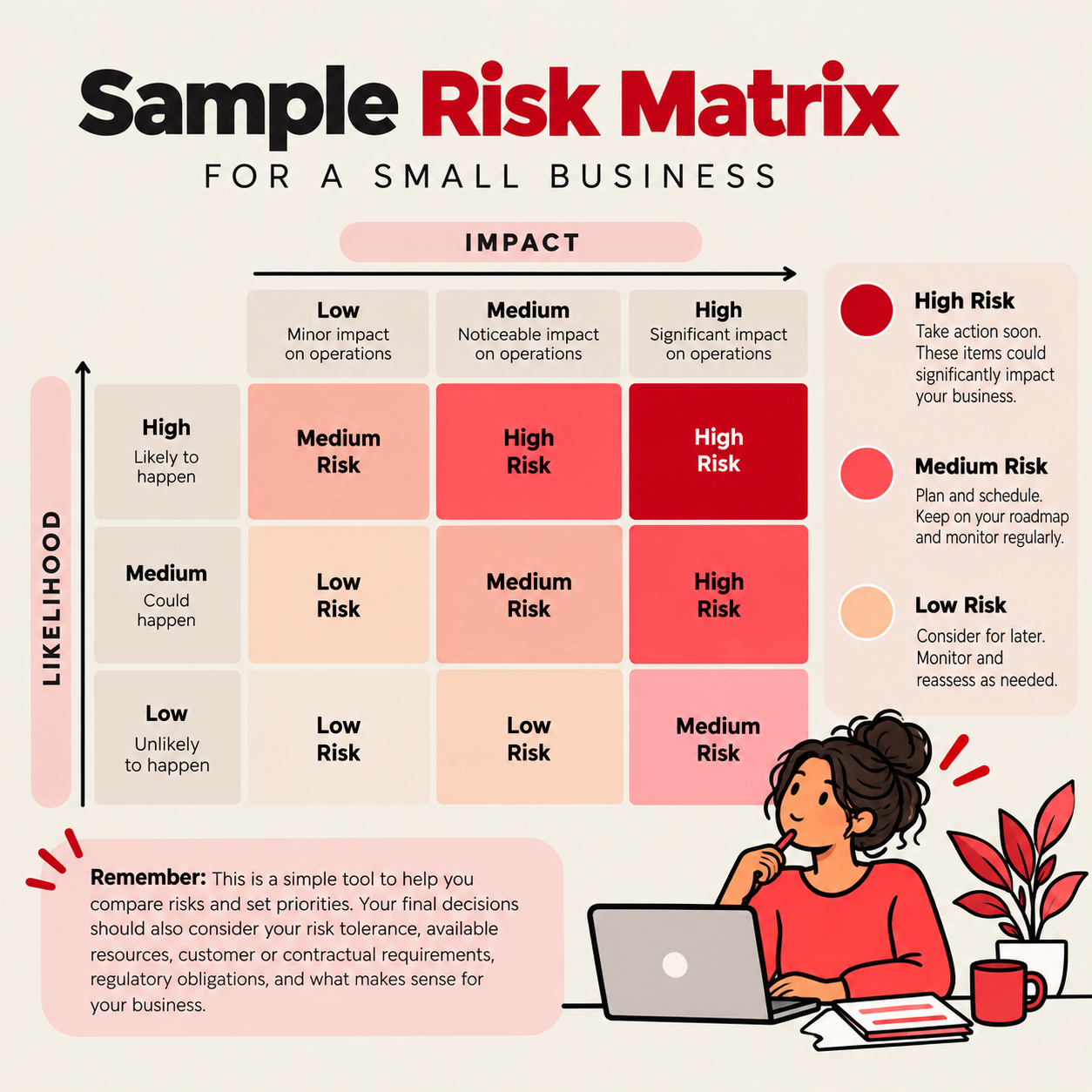
Use a simple risk matrix to help set priorities
Now you can start putting your list in order based on what matters most to your small business.
A simple risk matrix can help. You don't need a complicated scoring system or enterprise risk model. The goal is simply to give your team a consistent way to think about two things:
Likelihood: How likely is it that this issue could cause a problem?
Impact: If it did happen, how significant would the consequences be for your business?
You might rate each as Low, Medium, or High. From there, you can use the combination of likelihood and impact to get a general sense of the risk.
For example, an improvement tied to something that is both highly likely to occur and could significantly disrupt your business would probably deserve attention sooner than something with a low likelihood and relatively minor impact.
But remember: your risk matrix is a decision-making tool, not the decision-maker.
Your priorities should also reflect your:
Risk tolerance
Available resources
Customer or contractual requirements
Regulatory obligations
Other factors critical for your operations
Two businesses could identify the exact same security gap and reasonably decide it represents very different levels of risk.
Two businesses could identify the exact same security gap and reasonably decide it represents very different levels of risk.
That's why your roadmap shouldn't simply follow someone else's list of cybersecurity priorities. It should reflect your business, your risks, and the level of risk you're comfortable accepting.
Save and share this infographic with your team!
5. Prioritize what matters most
Now you can start putting your list in order based on what matters most to your small business.
This is where a simple risk matrix can be valuable. It gives your team a consistent way to compare improvements and make more informed decisions about what should happen first.
Your priorities should reflect the risks specific to your business, as well as your business's own risk tolerance. An issue that's high priority for one business may be much less significant for another.
The goal isn't to let a risk matrix make the decision for you. It's to give your team a clearer, more consistent way to make that decision.
A simple approach might be:
High priority: Significant risk or critical business requirement. Address soon.
Medium priority: Meaningful improvement, but not immediately urgent.
Lower priority: Worth doing, but reasonable to address as resources allow.
You can also consider:
Potential business impact
Likelihood of the problem occurring
Customer or contractual requirements
Compliance obligations
Cost
Time required
Difficulty
Dependencies on other projects
Don't confuse priority with complexity.
A security improvement can be extremely important and surprisingly easy to implement.
If something significantly reduces risk and takes relatively little effort, it may belong near the top of the list.
6. Decide what you can realistically accomplish now, and in the future
Prioritization isn't only about risk.
It's also about reality.
Small businesses have limited time, budgets, and people. A roadmap should reflect those constraints rather than pretending they don't exist.
For each improvement, consider: What will this require?
Maybe it's primarily staff time.
Maybe you need your MSP.
Maybe it requires new software.
Maybe it needs legal or cybersecurity expertise.
Maybe it requires budget you won't have until next quarter.
That doesn't mean an improvement that feels out of reach should be removed from your roadmap.
It means you can plan for it.
Keeping it visible gives your business a chance to plan for it, identify what resources or expertise you'll need, and revisit it as your priorities, budget, and capacity change.
Some improvements may need to happen now. Others may belong further down the road.
The goal isn't to only document what you can accomplish today. It's to create a realistic path toward stronger, more mature cybersecurity over time.
A realistic plan you'll follow is more valuable than a perfect plan you can't execute.
Keep it visible.
Not yet doesn't mean not important.
Some improvements can wait, but they shouldn't disappear.
Keep them on your roadmap so you know what's next, even when your time, budget, or resources are limited.
Revisit your priorities as your business grows, celebrate the progress you've made.
And remember that building a stronger business happens one thoughtful improvement at a time.
Every improvement listed on your Security Improvement Roadmap needs someone responsible for moving it forward.
Depending on the improvement, that might mean managing the project, coordinating with other team members, determining budgets and timelines, researching options, or bringing in outside expertise when needed.
That doesn't necessarily mean the owner has to do all the work themselves. Their job is to make sure the improvement keeps moving, the right people are involved, and it doesn't quietly fall off the priority list.
That doesn't necessarily mean the owner has to do all the work themselves. Their job is to make sure the improvement keeps moving.
The owner might coordinate with your:
IT provider
MSP
Cybersecurity consultant
Insurance broker
Legal counsel
Software vendor
Internal leadership team
Their job is to make sure the improvement keeps moving.
“Someone should do this” is where a lot of good security ideas stop.
Give ownership a name.
Ownership creates accountability. It turns “someone should do this” into “we know who's moving this forward.”
8. Set a realistic target date
Next, decide when you want the improvement completed.
Your risk matrix helps you understand what matters most. Your roadmap helps you decide when you're going to do something about it.
Not every project needs to happen this month, or even this year, and trying to tackle everything at once can make it harder to make meaningful progress on the most critical items on your Security Improvement Roadmap.
Your risk matrix helps you understand what matters most. Your roadmap helps you decide when you're going to do something about it.
Your target dates should reflect both:
How important an improvement is, and...
What your business can realistically accomplish.
This is another place where the simple risk matrix you created earlier can help guide your decisions. Improvements associated with higher risks may need to move forward sooner, while lower-risk improvements may reasonably happen later.
But risk isn't the only consideration.
Think about the owner you've assigned, your available budget and resources, how much time the improvement will take, whether you need outside expertise, and whether another project needs to happen first.
For a small business, you don't necessarily need exact deadlines for every improvement. A simple Now, Next, Later approach can be enough to begin to create direction and keep your roadmap realistic.
Some might be:
Now: Urgent or high-value improvements that should be addressed first. These may relate to higher risks identified in your risk matrix, immediate business needs, customer or contractual requirements, or improvements that are relatively easy to implement but could meaningfully reduce risk.
Next: Important improvements that don't require immediate action but should remain a priority. These are projects your business can reasonably plan for over the next few months as time, budget, and resources become available.
Later:Worthwhile improvements that may require more planning, investment, expertise, or resources. Putting something in “Later” doesn't mean it isn't important. It means you've made an intentional decision about when it makes sense to address it.
You can also use specific target dates if that works better for your team. And your timelines don't have to be permanent. As your risks, resources, or business priorities change, your roadmap should change with them.
A recommendation without a timeline can very easily become a recommendation you forget, only to rediscover next year.
9. Document the roadmap
At this point, your roadmap can be surprisingly simple.
You want it to capture the improvement you've identified, why it matters or the impact it could have, how critical it is, who owns it, when you're targeting completion, and its current status.
Be specific. Specificity allows you to understand exactly what you're trying to accomplish, track whether progress is actually being made, and know when an improvement can truly be considered complete.
Your roadmap doesn't need to be complicated. It just needs to be specific enough to be actionable.
The same principle applies to the rest of your roadmap. Instead of just “high risk,” also capture why it matters. Instead of “IT” as the owner, identify the name of one person responsible for moving it forward. Instead of “soon,” give it a target date.
Your roadmap doesn't need to be complicated. It just needs to be specific enough to be actionable so that someone can look at it and understand what needs to happen next.
Improvement
Why It Matters
Priority
Owner
Target Date
Status
Enable MFA for all employees
Reduce account compromise risk
High
[Name]; IT
Nov. 15
In Progress
Implement security awareness training
Reduce employee-related security risk
High
[Name]; Operations
Dec. 1
Planned
Review vendor access
Reduce unnecessary third-party access
Medium
[Name]; IT
Jan. 15
Planned
Update Incident Response Plan
Improve response readiness
Medium
[Name]; Operations
Feb. 1
Planned
You can add more fields as your process matures, such as:
Estimated cost
Actual cost
Source of recommendation
Related risk
Dependencies
Notes
Completion date
Supporting evidence
But don't make the system so complicated that maintaining the roadmap becomes its own project.
Simple is a feature.
Your roadmap doesn't need to look impressive. It needs to get used.
A spreadsheet your team reviews every month is more valuable than an elaborate security program nobody maintains.
10. Review, update, and keep improving
Your cybersecurity roadmap isn't something you create once and file away.
Set a regular cadence to review it.
That might be monthly for an active roadmap or quarterly when things are moving more slowly.
During each review, ask:
What's been completed?
What's currently in progress?
What's stuck?
Have priorities changed?
Have we identified any new risks or improvements?
Do any target dates need to change?
As projects are completed, mark them complete and keep the record.
That history matters.
Over time, your roadmap becomes evidence of something bigger than individual security projects:
It shows that your business has a process for identifying risk and getting better.
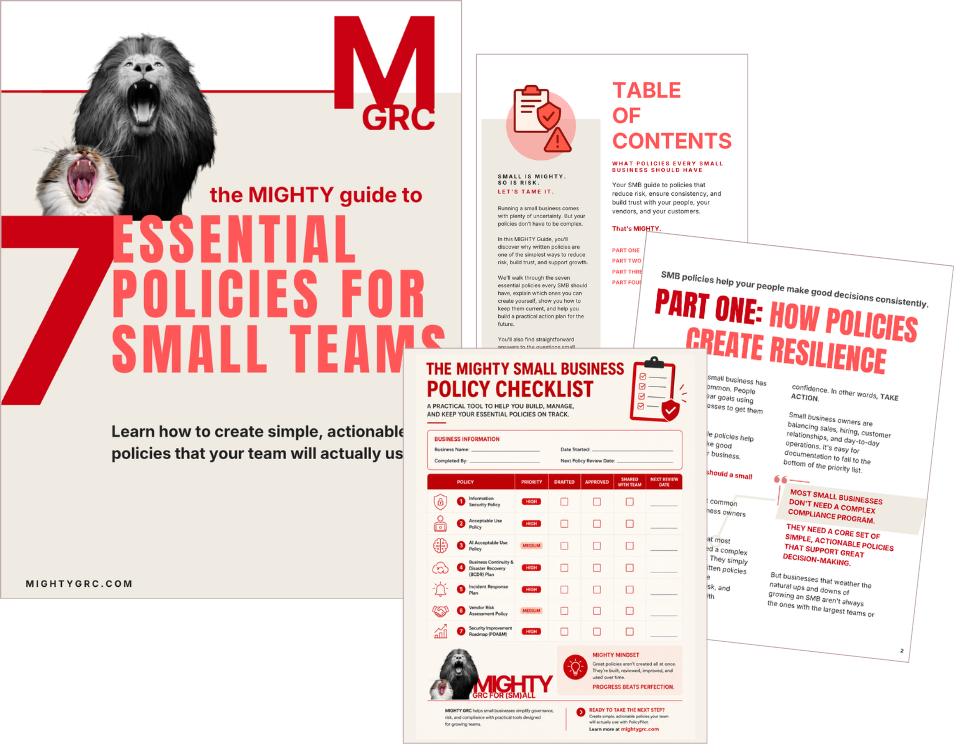
The MIGHTY Guide to 7 Small Business Policiesemphasizes this same habit: document the improvements you've identified, assign ownership, and review progress regularly. The format matters less than building the habit.
What's the difference between a Cybersecurity Roadmap and a POA&M?
If you've worked with government contracts, cybersecurity frameworks, or compliance programs, you may have encountered the term Plan of Action and Milestones, usually shortened to POA&M.
The terminology can sound intimidating.
The underlying concept isn't.
A POA&M is essentially a prioritized plan identifying what needs to be improved, who is responsible, and when the work should be completed.
For most small businesses, we prefer the term Security Improvement Roadmap because it better describes what you're actually trying to accomplish.
You're building a roadmap toward a more secure foundation for your business to operate from.
Depending on your regulatory or contractual requirements, you may eventually need a more formal POA&M structure.
But you don't need to wait for a compliance requirement to start creating a security-first culture in your small business.
How should you identify cybersecurity gaps?
This is one of the most important parts of building a useful roadmap.
Your roadmap shouldn't be based solely on a generic cybersecurity checklist.
It should reflect your business.
Improvements may come from:
Your policies
Cybersecurity assessments
IT reviews
Customer security questionnaires
Cyber insurance requirements
Compliance frameworks
Vendor assessments
Vulnerability scans
Penetration tests
Security incidents
Employee feedback
New technology
Changes in your business
This is also where your other security policies become useful.
They helped you identify where your business can get stronger.
Your Security Improvement Roadmap gives those improvements somewhere to go.
Your policies don't have to describe the perfect business
This is an important point, especially for growing businesses.
It can be tempting to think:
We can't write that into our policy because we don't do it yet.
Your policies should be honest about how your business operates today.
But discovering that your current practices don't yet match where you want to be isn't a reason to stop.
It's an opportunity to improve.
Instead of quietly losing that insight, put the improvement on your roadmap.
Your policies help define how your business operates today. Your roadmap helps you make that business stronger over time.
Your policies help define how your business operates today. Your roadmap helps you make that business stronger over time.
That's one reason we consider the Security Improvement Roadmap part of the core policy foundation for a small business. In the MIGHTY Guide, its business outcome is straightforward: build stronger security over time.
Can you create a Cybersecurity Roadmap yourself?
Absolutely.
In fact, this is one of the best cybersecurity tools for a small business to own internally.
Your team understands your priorities, budget, customers, technology, and operational realities better than anyone else.
Start with the improvements you've already identified.
Put them in one place.
Prioritize them.
Assign ownership.
Set realistic timelines.
Then review your progress regularly.
But that doesn't mean you have to identify every improvement yourself.
Knowing what to fix can be harder than tracking it
Creating the roadmap itself is relatively straightforward.
Knowing what should go on it can be harder.
That's where outside expertise can be especially valuable.
Your MSP or IT provider may identify technology gaps.
A cybersecurity professional can help assess security risks.
Your insurance broker can help you understand insurer expectations.
Legal or privacy professionals can identify requirements related to the information you handle.
The roadmap gives all of those recommendations one place to live.
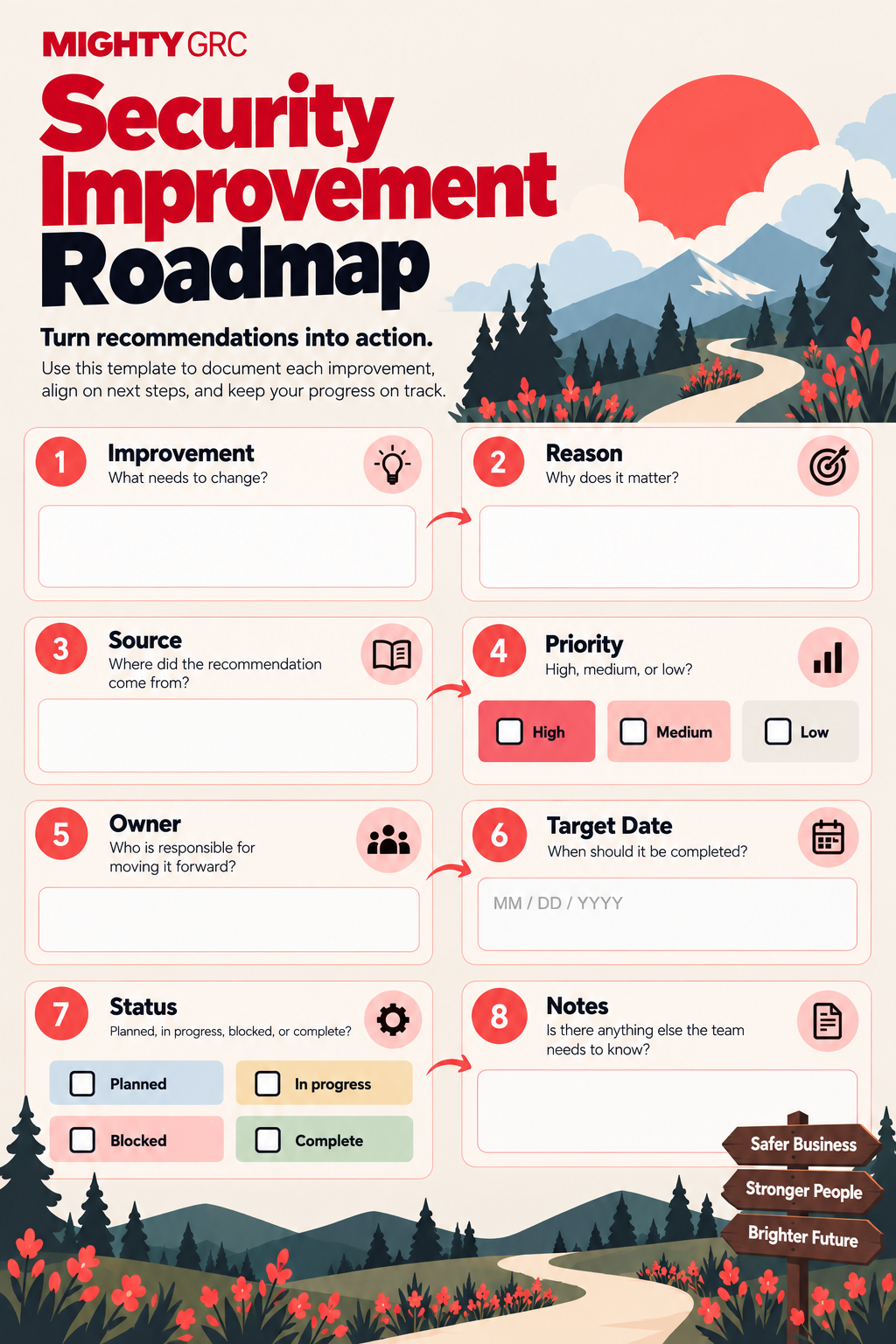
A simple Cybersecurity Roadmap template
If you're starting from scratch, keep it simple.
For each improvement, document:
Improvement: What needs to change?
Reason: Why does it matter?
Source: Where did the recommendation come from?
Priority: High, medium, or low?
Owner: Who is responsible for moving it forward?
Target Date: When should it be completed?
Status: Planned, in progress, blocked, or complete?
Notes: Is there anything else the team needs to know?
That's enough to start.
You can always make your process more sophisticated as your business grows.
Save and share this infographic with your team!
From good intentions to measurable progress
Every business has things it could improve.
That's normal.
Strong cybersecurity isn't about reaching a point where there's nothing left on the list.
It's about having a reliable process for deciding what to improve next.
A cybersecurity roadmap gives your business that process.
Instead of recommendations disappearing into emails, meeting notes, customer questionnaires, and forgotten to-do lists, they become part of a deliberate improvement plan.
You know what you're working on.
You know why it matters.
You know who's responsible.
And you know what comes next.
That's how good intentions become measurable progress.
Not sure where to start?
The Mighty Guide to SMB Policies
Get your free MIGHTY Guide to writing your first Security Improvement Roadmap, and take the first steps toward building a practical policy program that includes Information Security, Acceptable Use, AI, Incident Response, and more.
Start with a Security Roadmap. Build a stronger business.
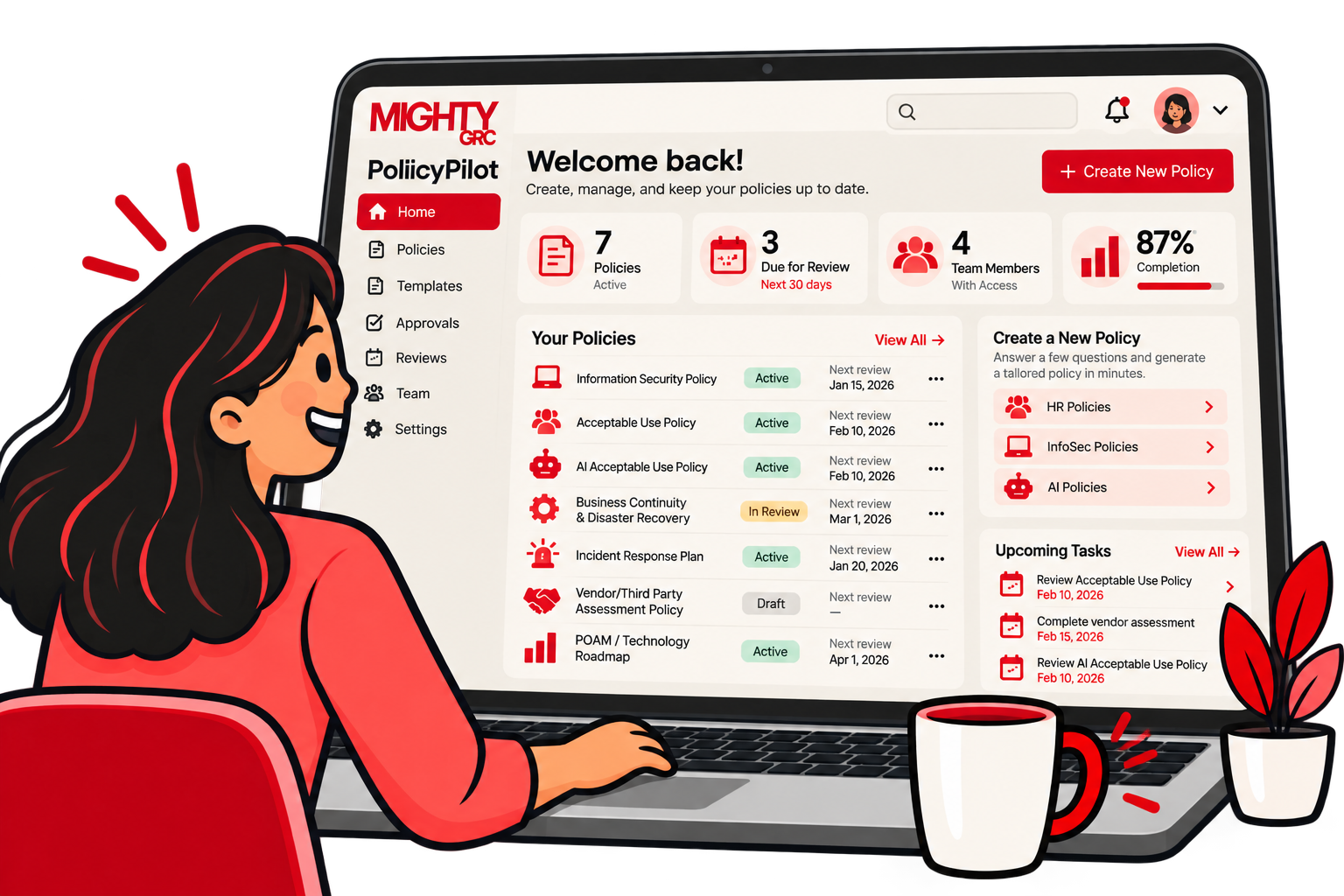
PolicyPilot by MIGHTY GRC helps small businesses turn complex policy requirements into clear, tailored policies built around how their business actually operates.
Cybersecurity improvements shouldn't disappear into spreadsheets, inboxes, and forgotten meeting notes.
Answer a few straightforward questions, and in minutes you can:
Customize your Security Improvement Roadmap for your real world business.
Manage policy reviews and approvals in one place.
Use automated reminders to keep your Security Improvement Roadmap current.
Because identifying an improvement is only the beginning. What matters is what action you take next.
Your policies should be simple. They should be actionable.
And they should actually get used.
Explore PolicyPilot today and start building your Cybersecurity Roadmap in minutes.
Thank you from the MIGHTY team. We are dedicated to offering learning resources for small and midsized businesses that are supportive, actionable, and will actually get used.
This article is provided for educational and informational purposes only. It is intended to help small businesses better understand governance, risk, compliance, and policy management, but it is not legal, financial, cybersecurity, insurance, or other professional advice.
Use this content as a starting point for building a stronger, more resilient business—not as a substitute for professional advice tailored to your specific needs.



 Your roadmap helps you decide what needs attention now, what can wait, and what you're going to do next.

 Your existing list is a great starting point.

 Prioritization isn't only about risk.
 Next, decide when you want the improvement completed.
 At this point, your roadmap can be surprisingly simple.
 Your cybersecurity roadmap isn't something you create once and file away.