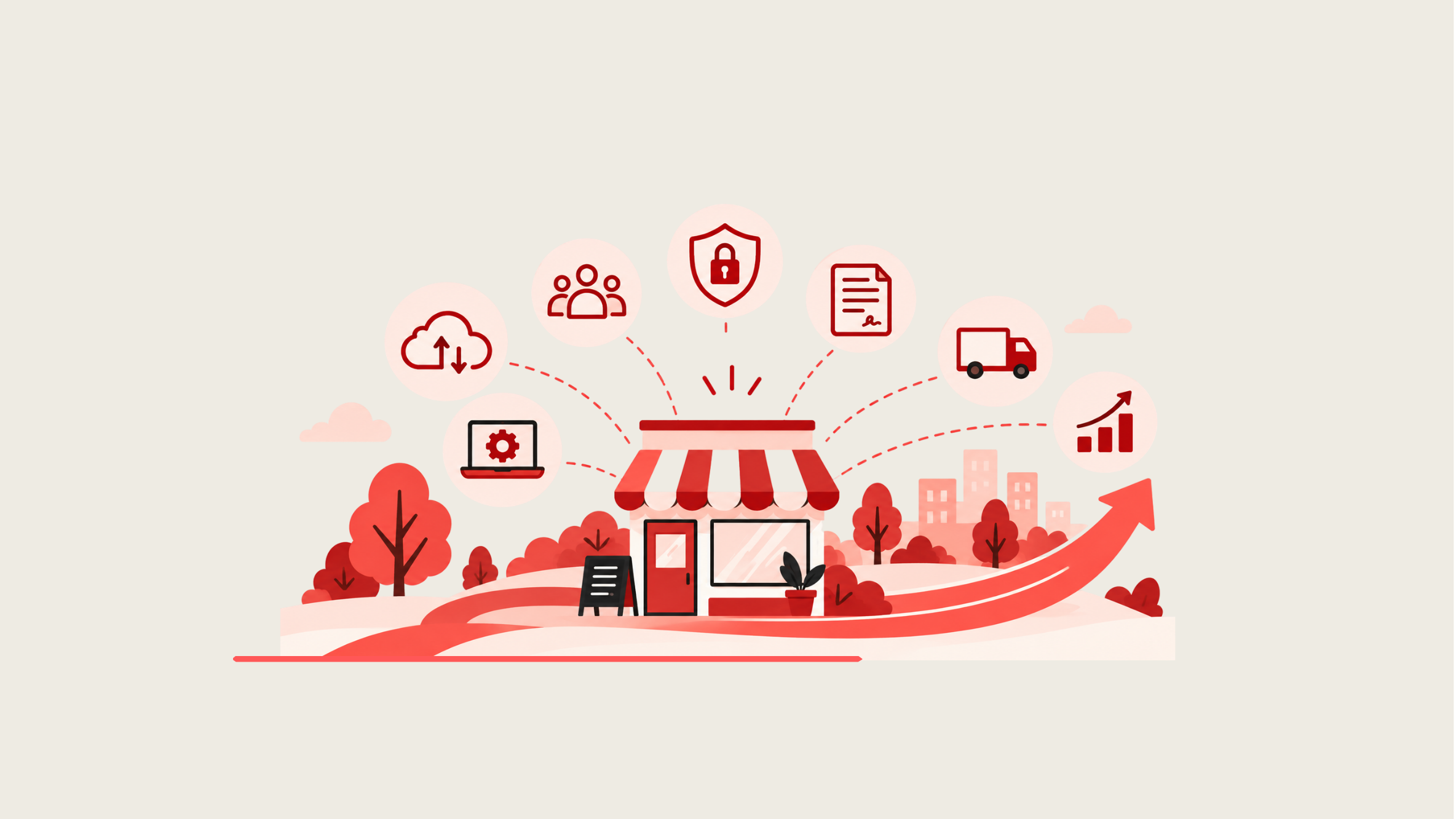
Business ResilienceCybersecurity for Small BusinessRisk Mitigation
The Benefits of Cybersecurity Roadmap Planning for Your Small Business
Aaron Mejia, MIGHTY CoFounder & CTO
Cybersecurity can feel like a never-ending list of things your small business should be doing.
Improve your backups. Turn on multi-factor authentication. Update an old policy. Train employees. Review vendor access. Replace outdated technology. Follow up on that recommendation your IT provider made six months ago.
The list can get long quickly.
But for most small businesses, the challenge isn't recognizing that there are things you could improve. It's figuring out what matters most, what you can realistically accomplish, and what you should do next.
That's where cybersecurity planning can make a big difference.
A cybersecurity roadmap, or what we call a Security Improvement Roadmap at MIGHTY GRC, turns scattered recommendations and good intentions into an organized plan for improving your security over time.
And its benefits extend far beyond cybersecurity.
A good roadmap can help you make smarter investments for your business, create a better experience for your team, and build customer trust.
A good roadmap can help you make smarter investments for your business, create a better experience for your team, build customer trust, reduce unnecessary disruption, strengthen resilience, and prepare your business for growth.
You don't need to be a cybersecurity expert to benefit from cybersecurity planning. In fact, that's actually why you need one.
A good roadmap gives you a way to turn cybersecurity recommendations into business decisions you can understand, prioritize, budget for, and act on.
What is a Cybersecurity Roadmap?
A cybersecurity roadmap is a documented plan for strengthening your business's cybersecurity over time.
It takes the improvements you've identified and gives them structure. Instead of keeping recommendations in emails, meeting notes, assessment reports, spreadsheets, or someone's head, your roadmap brings them together so you can decide:
At MIGHTY GRC, we prefer Security Improvement Roadmap because that's really what it is: a practical path for getting from where your business is today to where you want it to be.
And you don't have to get there all at once.
Progress beats perfection.
Here's a sample Security Improvement Roadmap Template for assessing individual cybersecurity gaps in your small or midsized business. You can save and share this infographic with your team!
The BIG picture business benefits of cybersecurity planning
When we talk about cybersecurity planning, it's easy to focus on the obvious outcome: a more secure business.
But security is only one part of building a resilient small business.
A strong business also needs to be financially healthy, productive, prepared for disruption, and able to adapt as it grows. It needs a team that understands what's expected, has the confidence to make decisions, and can do great work without unnecessary friction. And it needs customers who trust the business and feel confident continuing to work with it.
You can think about resilience as strengthening three important parts of your business:
A strong business
One that is secure, financially responsible, productive, prepared, and able to keep moving when something unexpected happens.
A strong team
One where people have clear expectations, useful tools, and enough autonomy to make good decisions, do their jobs well, and feel confident in the business they're helping build.
Strong customer relationships
Customers trust you with their information and their business. They know what to expect, find you easy to work with, and feel confident that your company will be there when they need you.
And underneath all three is something even more fundamental: the relationships people have with your business.
As an owner or leader, do you feel confident in the business you're building, or are you constantly reacting to the next problem?
Do employees feel supported and empowered, or frustrated by unclear expectations and processes?
Do customers see a capable, dependable partner they can trust?
Good cybersecurity planning can strengthen all of those relationships.
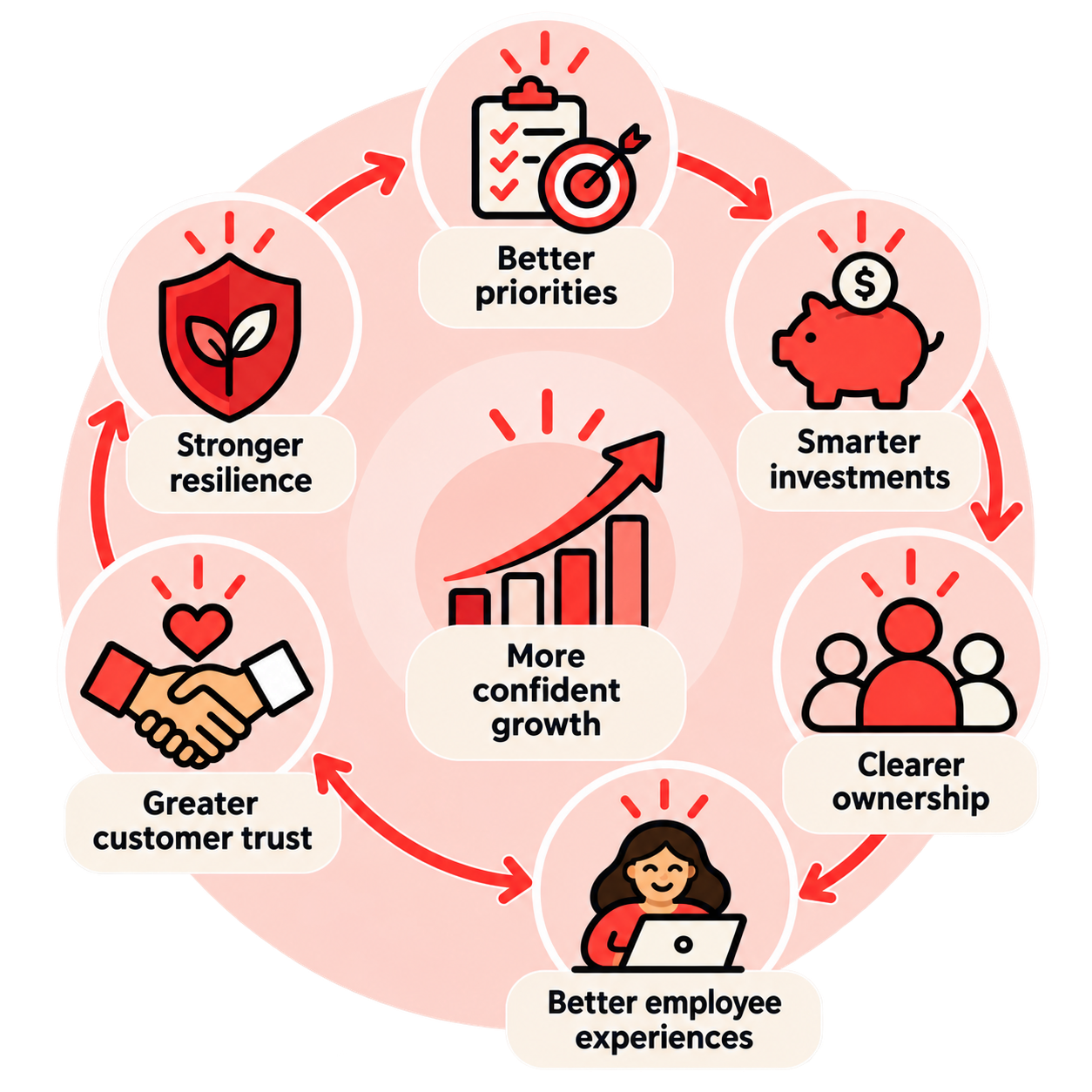
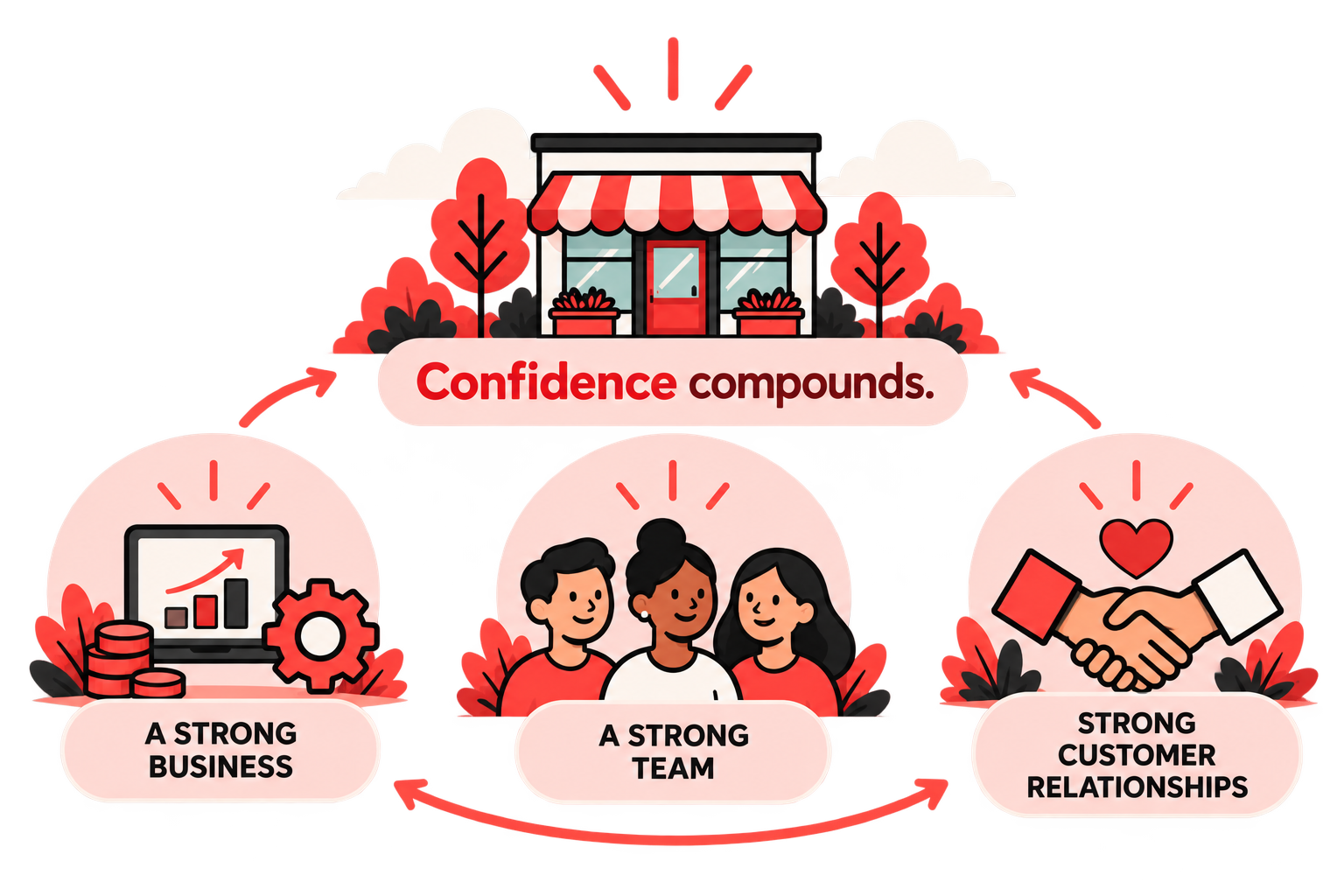
And confidence compounds.
Owner confidence → I understand my business and can make better decisions. Team confidence → I know what's expected and can act autonomously. Customer confidence → I trust this company and want to keep doing business with it.
That's why the benefits of a Security Improvement Roadmap extend far beyond cybersecurity. The 12 benefits below aren't just about reducing risk. They're about helping you build a stronger business, a stronger team, and stronger relationships with the customers who depend on you.
1. Focus your limited resources where they matter most
Small businesses make tradeoffs every day.
There is only so much time, money, and employee capacity available, and cybersecurity is competing with every other priority your business has.
A roadmap helps you make those tradeoffs strategically.
Small businesses make tradeoffs every day. A Security Improvement Roadmap helps you make those tradeoffs strategically.
Instead of treating every recommendation as equally urgent, you can look at the risk it represents to your specific business and decide where action will have the greatest impact.
This is where a simple risk matrix can be particularly useful. If you've already considered the likelihood and potential impact of different risks, you can use that information to help prioritize the improvements on your roadmap.
Save and share this infographic with your team!
A high-risk issue that could significantly interrupt operations may deserve attention before a lower-risk improvement, even if the lower-risk project is easier to complete.
Your roadmap helps you move from "we should probably do this" to "this is what matters most right now."
IMPACT BADGE
2. Make smarter cybersecurity investments
Cybersecurity spending can become surprisingly reactive.
Your IT provider recommends a new tool. Your cyber insurer asks for a new control. A customer security questionnaire reveals a gap. Someone attends a webinar and comes back with another piece of software the company has to buy.
Individually, every recommendation may sound reasonable.
But that doesn't necessarily mean every recommendation is the right investment for your business right now.
Cybersecurity then becomes less about buying things and more about making thoughtful business decisions.
A roadmap lets you strategically and intentionally consider cybersecurity investments together rather than one at a time.
Before spending money, you can ask:
What risk are we trying to reduce?
How important is that risk to our business?
What other improvements are competing for these resources?
Is this the best next investment we can make in our business at this time?
Cybersecurity then becomes less about buying things and more about making thoughtful business decisions.
IMPACT BADGE
3. Plan for security costs before they surprise you
Not every cybersecurity expense can be predicted.
But many can.
Maybe you know you'll eventually need to replace outdated technology. Your backup system needs improvement. You need outside expertise to complete an assessment. Your cyber insurance renewal may require additional controls.
Putting those improvements on your roadmap gives you visibility before they become urgent.
That can help leadership anticipate costs, incorporate improvements into future budgets, and decide whether projects should happen now, next, or later.
And an improvement doesn't disappear simply because you can't afford to complete it today.
Keeping it on your roadmap gives you an opportunity to plan for it.
"Not yet" can be a perfectly reasonable business decision when it's an intentional one.
IMPACT BADGE
4. Give your team clearer expectations
Your team plays an important role in protecting your business, but they shouldn't have to guess what good security looks like.
When security practices are unclear, your team is left to make their own decisions about passwords, data sharing, software, AI tools, devices, vendors, suspicious emails, and dozens of other everyday situations.
Policies help establish expectations.
Your Security Improvement Roadmap helps you improve the environment around those expectations.
Team members may need better training.
An existing process may be confusing.
The technology your team is using may make following the policy unnecessarily difficult.
You may have identified an access problem that needs to be fixed.
A roadmap gives those improvements somewhere to go.
The result can be a security-first culture that feels less like a collection of rules and more like a business making it easier for its people to make good decisions.
IMPACT BADGES
5. Reduce friction and improve productivity
Strong cybersecurity and productivity shouldn't be opposing goals.
In fact, some of the best security improvements can make work easier.
Outdated technology, confusing access controls, manual workarounds, unclear processes, duplicate systems, and inconsistent practices don't just create security risk. They can slow your team down.
Your roadmap gives you an opportunity to look for improvements that accomplish both goals.
Outdated technology can slow your team down.
For example:
Implementing a password manager could strengthen password practices while making it easier for employees to manage their accounts.
Improving your onboarding and offboarding process can strengthen access control while making hiring and employee transitions more efficient.
Good governance creates guardrails, not roadblocks.
The goal isn't to add security steps simply for the sake of adding them. It's to create an environment where secure ways of working are also practical ways of working.
IMPACT BADGES
Good governance should make work easier.
Security and productivity don't have to compete.
The best policies create clear guardrails that help employees understand what's expected, make everyday decisions with greater confidence, and keep work moving without constantly stopping to ask for direction.
When expectations are clear, your team can spend less time figuring out how to work and more time actually doing the work.
6. Keep security from becoming a leadership bottleneck
Without a plan, every cybersecurity recommendation can become another decision leadership has to make from scratch.
But if you've already documented why the improvement matters, established its priority, assigned an owner, and decided when you want to address it, you can allow your team some autonomy to take over and move the projects forward.
Should we do this?
Who should handle it?
How urgent is it?
Didn't our IT provider mention this before?
What did we decide last time?
A Security Improvement Roadmap captures those decisions and ensures they are accessible to your entire team.
That gives employees more direction and reduces the amount of information that has to live in the heads of owners and leaders.
Instead of repeatedly deciding what to do, your team can focus on moving the work forward.
IMPACT BADGES
7. Build employee ownership and a stronger culture of security
A culture of security isn't created by telling your team that cybersecurity is important.
It's created when people see that security is part of how the business operates.
Security becomes embedded in your team and business culture if:
An employee identifies a concern, there should be somewhere for that concern to go.
A team identifies an improvement, someone should be responsible for moving it forward.
The business decides something matters, employees should eventually see action.
Your roadmap helps create that connection.
It shows your team that cybersecurity isn't just an annual training exercise or something the IT provider handles behind the scenes. It's an ongoing business responsibility with priorities, owners, decisions, and progress.
And importantly, ownership doesn't mean doing everything yourself.
The person responsible for an improvement may coordinate other team members, determine budgets and timelines, research solutions, work with an IT provider, or bring in outside expertise.
Their job is to make sure the improvement keeps moving.
IMPACT BADGES
A culture of security is built, not announced.
Culture is about action and understanding, not static policies.
You can't create a security-first culture with an annual training session or a reminder that "security is everyone's responsibility."
It develops when employees understand what's expected, feel comfortable raising concerns, have the tools to make good decisions, and see that the business actually follows through when risks or opportunities for improvement are identified.
Over time, those everyday actions become simply how your team works.
8. Build and protect customer trust
Your customers may never see your Security Improvement Roadmap.
But they may see the results of it.
Increasingly, businesses are being asked how they protect information, manage vendors, control access, respond to incidents, maintain business continuity, and manage cybersecurity risk.
For small businesses selling to larger organizations, those questions can become particularly important.
A roadmap demonstrates something valuable: your business has a process for evaluating risk, prioritizing security needs, and continually improving over time.
A roadmap demonstrates something valuable: your business has a process for evaluating risk, prioritizing security needs, and continually improving over time.
You may not have implemented every possible security control. You may have gaps you're still working through.
That's okay.
What matters is that you understand those gaps, have evaluated their importance, and have a plan for addressing them.
Customers don't need your business to be perfect. They need reasons to trust that you're paying attention.
IMPACT BADGES
9. Respond more confidently to outside requirements
Cybersecurity recommendations can come from almost anywhere.
A customer security questionnaire may uncover one. Your cyber insurance application may uncover another. An assessment, consultant, compliance requirement, IT provider, vulnerability scan, or policy review might identify several more.
Without a roadmap, each new recommendation can feel like another fire drill.
With one, recommendations have somewhere to go.
You can document the recommendation, understand why it matters, evaluate its risk, compare it with your existing priorities, and decide what your business is going to do about it.
That doesn't mean every outside recommendation automatically becomes your highest priority.
It means you now have a consistent process for making that decision.
Recommendations become inputs into your planning process instead of interruptions to it.
IMPACT BADGES
10. Keep important business knowledge with the business
Small businesses often depend heavily on a relatively small number of people.
That can make institutional knowledge surprisingly fragile.
Maybe one employee knows what the IT consultant recommended last year. Another remembers why you decided not to replace a system. Your owner knows what the cyber insurer asked for. Someone else has a spreadsheet with the results of an old assessment.
Then someone changes roles, leaves the company, or simply forgets.
A roadmap creates a record of what your business has identified and decided.
It can tell you what needs to improve, why it matters, where the recommendation came from, how important it is, who owns it, when you plan to address it, and where it currently stands.
That means your security improvement process doesn't have to depend on one person's memory.
And that continuity becomes increasingly valuable as your team grows and changes.
IMPACT BADGES
11. Build a more resilient business
Cybersecurity isn't just about preventing cyberattacks.
It's also about your ability to keep operating when something doesn't go according to plan.
Backups can help you recover information. Better access controls can limit the impact of a compromised account. Employee training can help someone recognize and report a suspicious event quickly. Vendor improvements can reduce external dependencies. Incident response planning can help your team respond more confidently when something happens.
Individually, these are cybersecurity improvements.
Together, they help build business resiliency.
Individually, these are cybersecurity improvements. Together, they help build business resilience.
Your roadmap gives you a practical way to strengthen that resilience over time rather than trying to transform your entire security environment overnight.
A more secure business is a more resilient business.
And resilience matters because disruption isn't limited to cybersecurity incidents. Businesses face technology failures, vendor outages, employee changes, natural disasters, mistakes, and unexpected events of all kinds.
The stronger your underlying processes are, the better prepared your business is to adapt and keep moving.
IMPACT BADGES
Resilience isn't about preventing every problem.
Technology will fail.
Things will go wrong. Vendors will have outages. Employees will make mistakes. Unexpected events will happen.
A resilient business doesn't need to predict every disruption. It needs the clarity, processes, and people to adapt, make good decisions, and keep moving when something does.
Every thoughtful security improvement helps build more of that capacity.
12. Ensure your cybersecurity matures with your business
Growth is exciting.
It also creates change.
You hire more employees. Add new technology. Collect more information. Bring on new vendors. Serve larger customers. Enter new markets. Adopt AI. Sign more complicated contracts.
And every one of those changes can introduce new decisions and new risks.
Your cybersecurity practices at 10 employees probably shouldn't look exactly the same when you reach 25, 50, or 100.
A roadmap gives your security program room to mature alongside the business.
You can add new improvements as your needs change, revisit priorities as risks evolve, and continue strengthening your practices without trying to build an enterprise security program before you need one.
The goal isn't to build enterprise-level cybersecurity overnight. It's to make sure your cybersecurity can grow up alongside your business.
IMPACT BADGES
Confidence compounds: How security improvements snowball for small businesses
One of the most valuable things about cybersecurity improvements is that their benefits rarely stop with cybersecurity.
A clearer process might make your business more secure, but it can also make an employee's job easier. A better-prepared team can respond to problems faster, which helps protect your customers. Greater customer trust can strengthen relationships, create new opportunities, and ultimately make the business stronger.
One improvement can create benefits in more than one place.
That's why we've looked at each of the benefits above through three lenses:
A strong business
Secure, financially responsible, productive, prepared for disruption, and able to adapt as it grows.
A strong team
Clear on what's expected, equipped to make good decisions, able to work with greater autonomy, and confident in the business they're helping build.
Strong customer relationships
Built on trust, reliability, consistency, and an experience that makes your business easy to work with.
You may have noticed that some benefits strengthen two areas, while others strengthen all three. That's intentional.
The three aren't independent.
A stronger business can better support its people. A stronger team can create a better experience for customers. Stronger customer relationships can make the business even stronger.
And then the cycle continues.
How the roadmapping benefits add up
Cybersecurity Roadmap Benefit
Strong Business
Confident Team
Customer Relationships
1. Prioritize Resources
✓
2. Make Smarter Cybersecurity Investments
✓
3. Plan for Security Costs
✓
4. Give Your Team Clearer Expectations
✓
✓
5. Reduce Friction and Improve Productivity
✓
✓
6. Reduce Leadership Bottlenecks
✓
✓
7. Build Employee Ownership and Security Culture
✓
✓
8. Build and Protect Customer Trust
✓
✓
9. Respond Confidently to Outside Security Requirements
✓
✓
10. Keep Important Knowledge With the Business
✓
✓
11. Build a More Resilient Business
✓
✓
✓
12. Let Cybersecurity Mature With Your Business
✓
✓
✓
The top cybersecurity benefit is a stronger business ecosystem
This is where cybersecurity planning becomes much bigger than a list of technical improvements.
Imagine your roadmap identifies a need to improve employee onboarding and offboarding.
At first, that might look like a security project: make sure new employees receive the right access and former employees lose access promptly.
But improve that process and the benefits begin to snowball.
Your business has better control over its systems and information. Your team gets a smoother, more consistent onboarding experience with clearer access from day one. Your customers benefit from knowing their information is being handled by a company with thoughtful processes in place.
One improvement. Multiple outcomes.
The same thing can happen when you improve backups, clarify policies, introduce a password manager, strengthen vendor management, improve employee training, or build a better incident response process.
Cybersecurity planning becomes much bigger than a list of technical improvements.
Each improvement can make something else a little stronger.
And those small improvements add up.
How confidence compounds for secure small businesses
At MIGHTY GRC, one of our core beliefs is that confidence compounds.
Every time you understand a risk, make a thoughtful decision, and follow through on an improvement, you know a little more about your business.
Your processes get clearer. Your team becomes better equipped to make decisions. Your customers have more reasons to trust you. And the next decision becomes a little easier to make.
A practical way to keep building a stronger business, a stronger team, and stronger customer relationships, one thoughtful improvement at a time.
Ready to start building a MIGHTY foundation for your small business?
A Security Improvement Roadmap helps you decide what to improve next. But some of the most important improvements start with having the right policies in place.
Actionable, impactful policies don't work in isolation.
Because just like security improvements, actionable, impactful policies don't work in isolation.
Together, they help build a stronger, more resilient business.
Cybersecurity planning is really business planning
It's easy to think of a cybersecurity roadmap as an IT document.
But when it's done well, it's really a business decision-making tool.
It helps you decide where to spend money.
Where to spend time.
Which risks deserve attention.
Where employees need better support.
What customers may expect.
What your business depends on.
And what needs to improve next.
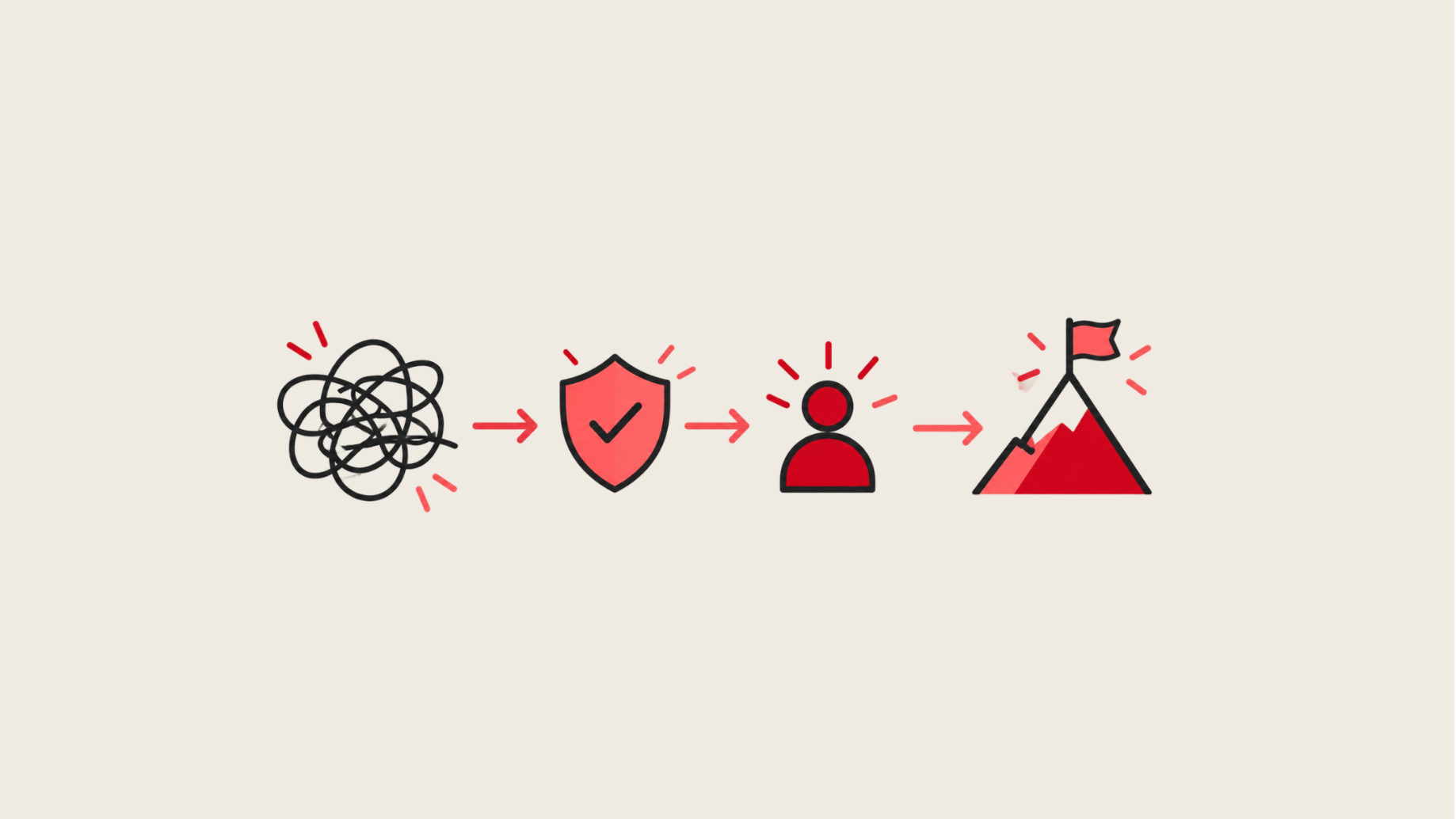
That's why cybersecurity planning can have an impact far beyond your security posture.
The progression looks something like this:
Remember, you don't need to accomplish everything today.
You just need a reliable way to understand where you are, decide where you're going, and keep making progress.
Ready to build your Security Improvement Roadmap?
You probably already have more of your roadmap than you think.
Recommendations may be sitting in an assessment, an IT provider's email, a cyber insurance application, a customer questionnaire, a policy review, meeting notes, or the minds of your employees.
The next step is bringing them together and turning them into action.
And with MIGHTY GRC, the gaps and recommendations you uncover while strengthening your governance and policies can become part of an actionable Security Improvement Roadmap your team can actually use.
Not sure where to start?
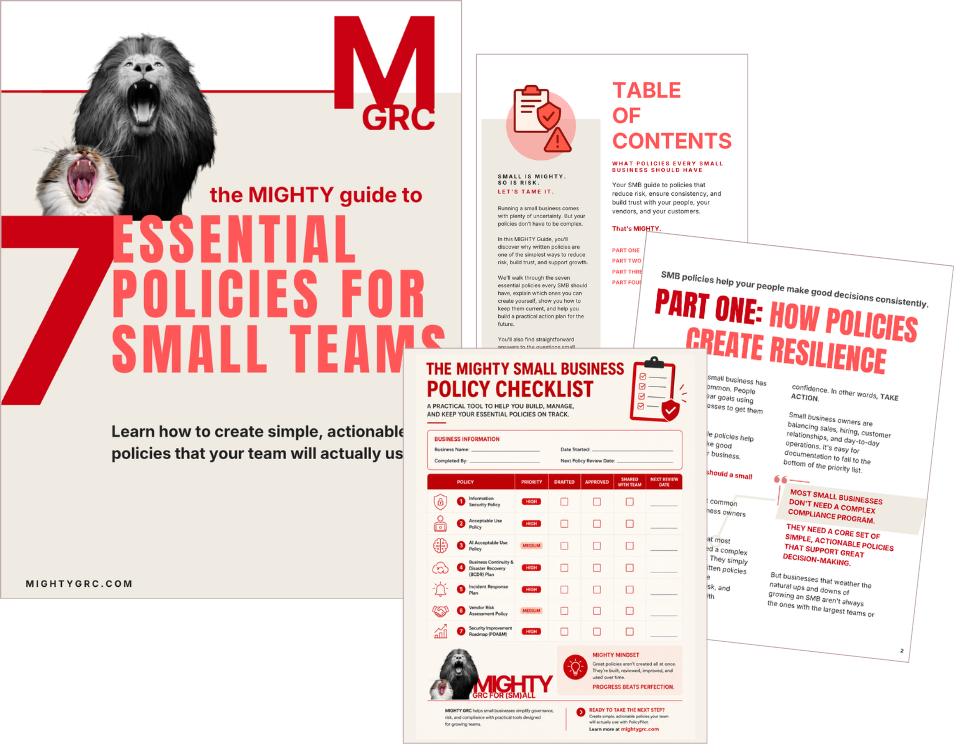
The Mighty Guide to SMB Policies
Get your free MIGHTY Guide to creating your first Security Improvement Roadmap, and take the first steps toward building a practical policy program that includes Information Security, AI, Business Continuity, Incident Response, and more.
Start with a Cybersecurity Roadmap. Build a stronger business.
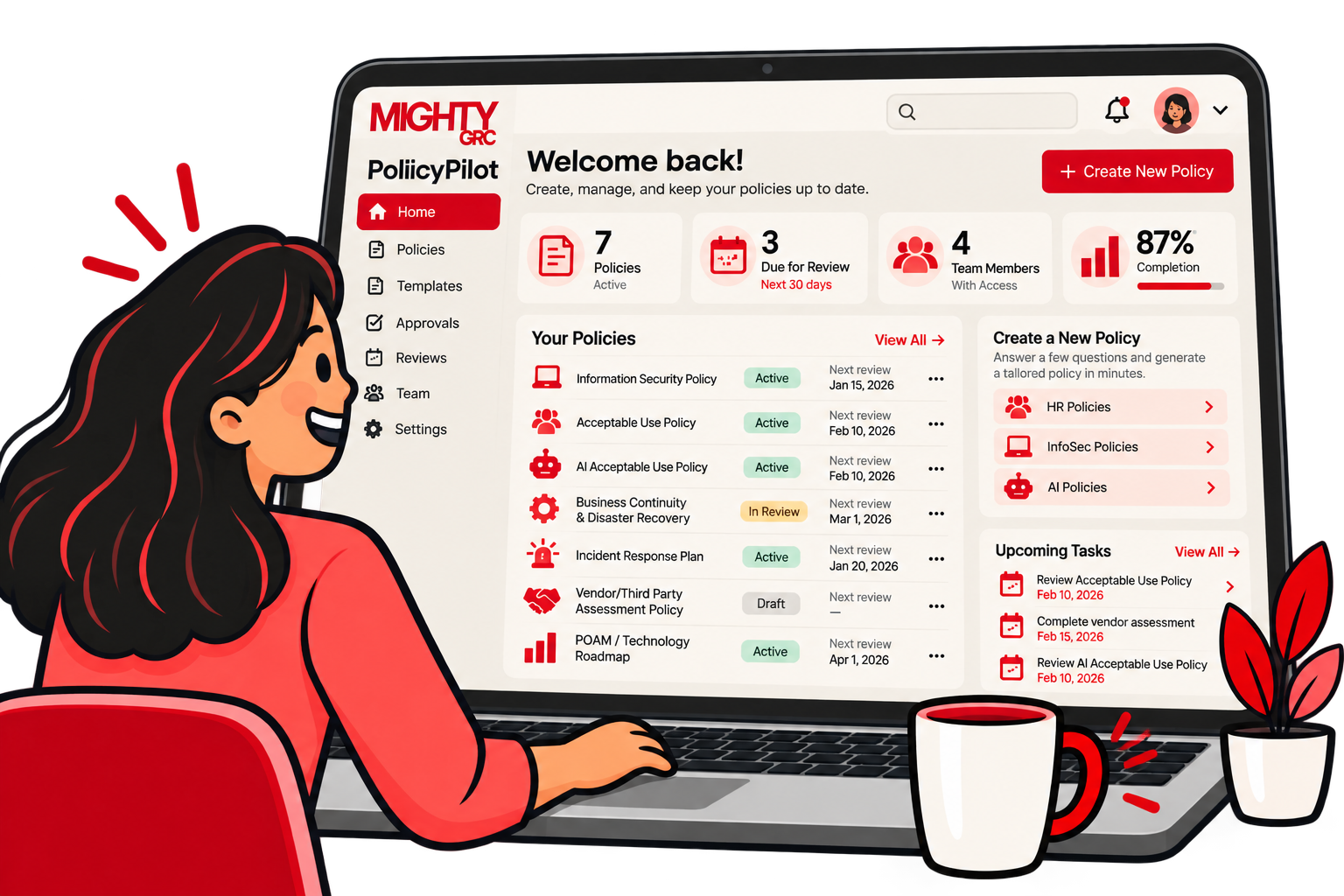
PolicyPilot by MIGHTY GRC helps small businesses turn complex policy requirements into clear, tailored policies built around how their business actually operates.
Creating a strong, actionable Security Improvement Roadmap can help you see where your business is already doing well and where there may be opportunities to improve.
Answer a few straightforward questions, and in minutes you can:
Customize your Cybersecurity Roadmap for your real world business.
Manage policy reviews and approvals in one place.
Use automated reminders to keep your Security Improvement Roadmap current.
Because good governance isn't about having everything figured out today. It's about taking the next right step.
Your policies should be simple. They should be actionable.
And they should actually get used.
Explore PolicyPilot today and start building your Cybersecurity Roadmap in minutes.
Thank you from the MIGHTY team. We are dedicated to offering learning resources for small and midsized businesses that are supportive, actionable, and will actually get used.
This article is provided for educational and informational purposes only. It is intended to help small businesses better understand governance, risk, compliance, and policy management, but it is not legal, financial, cybersecurity, insurance, or other professional advice.
Use this content as a starting point for building a stronger, more resilient business—not as a substitute for professional advice tailored to your specific needs.



 A good roadmap can help you make smarter investments for your business, create a better experience for your team, and build customer trust.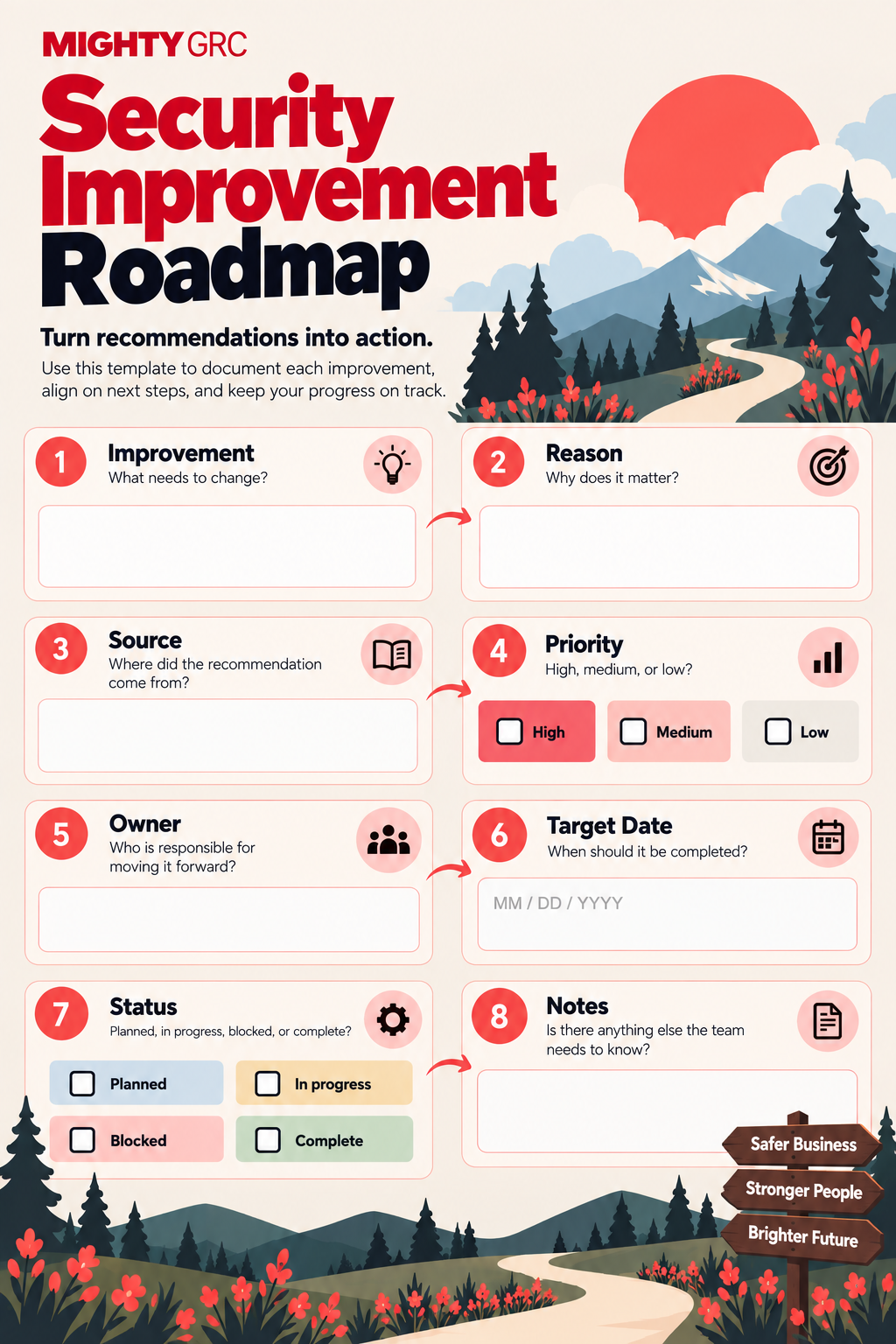
 Small businesses make tradeoffs every day.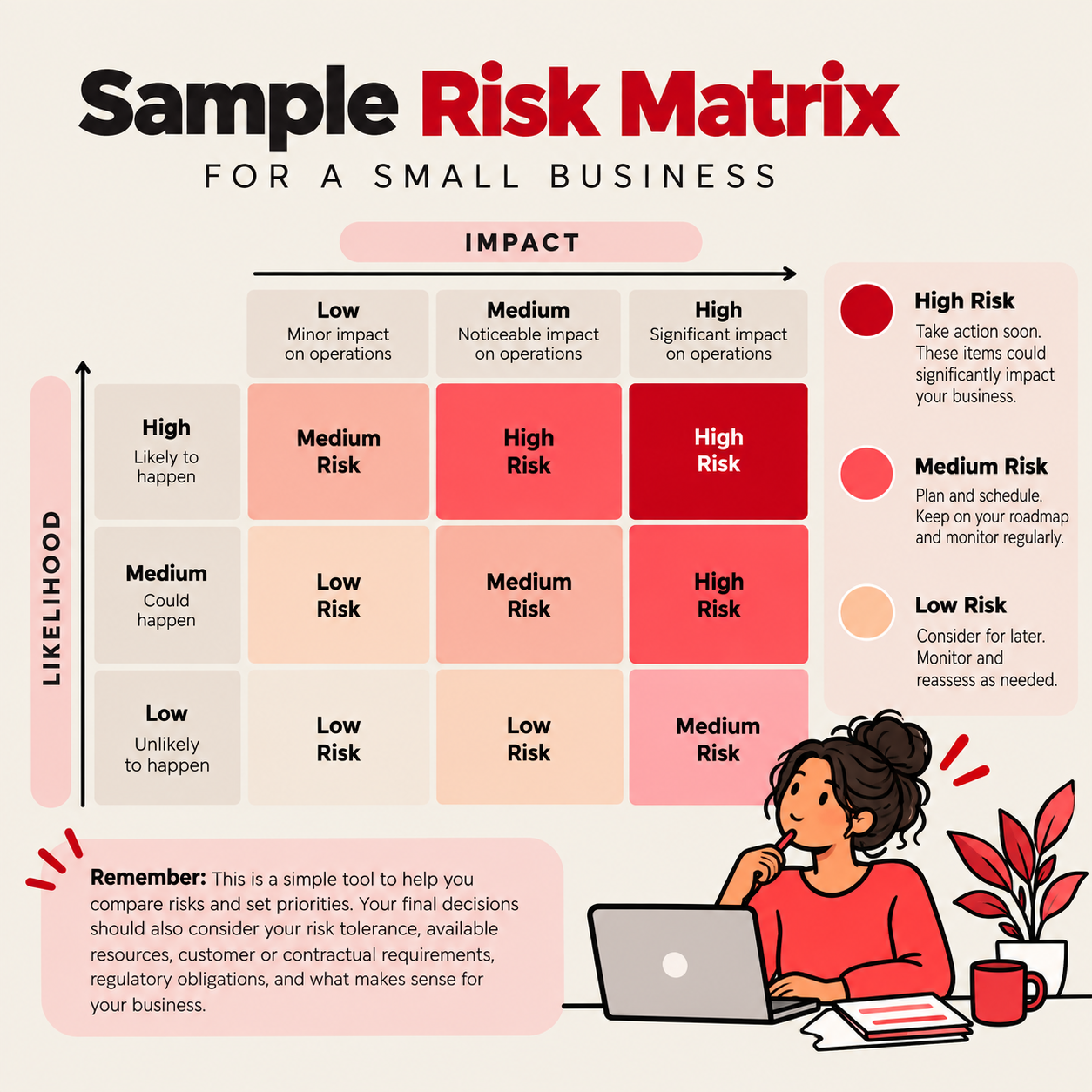

 Cybersecurity spending can become surprisingly reactive.
 Not every cybersecurity expense can be predicted.
 Your team plays an important role in protecting your business, but they shouldn't have to guess what good security looks like.
 Strong cybersecurity and productivity shouldn't be opposing goals.
 Without a plan, every cybersecurity recommendation can become another decision leadership has to make from scratch.
 A culture of security isn't created by telling your team that cybersecurity is important.
 Your customers may never see your Security Improvement Roadmap.
 Small businesses often depend heavily on a relatively small number of people.
 Cybersecurity isn't just about preventing cyberattacks.
 Growth is exciting.
 Imagine your roadmap identifies a need to improve employee onboarding and offboarding.