Technology gives small businesses incredible flexibility.
Your team can work from almost anywhere, collaborate in real time, introduce new applications quickly, automate repetitive work, and use tools that once would have been available only to much larger organizations.
But that flexibility also means employees make technology decisions every day.
Should I use this new application?
Can I access this file from my personal device?
Where should I save this customer information?
Is it okay to connect this tool to my company account?
What should I do with this suspicious email?
Can I enter this information into an AI platform?
Without shared expectations, different people and teams can answer those questions very differently.
That's why an Acceptable Use Policy, or AUP, creates so much value for a small business or team.
An Acceptable Use Policy doesn't have to mean more rules or less autonomy.
One of the biggest Acceptable Use Policy benefits is consistency. An effective AUP creates a shared foundation for how people across your business use technology, helping employees make better decisions while protecting information, supporting responsible technology adoption, and strengthening business resilience.
And importantly, an Acceptable Use Policy doesn't have to mean more rules or less autonomy.
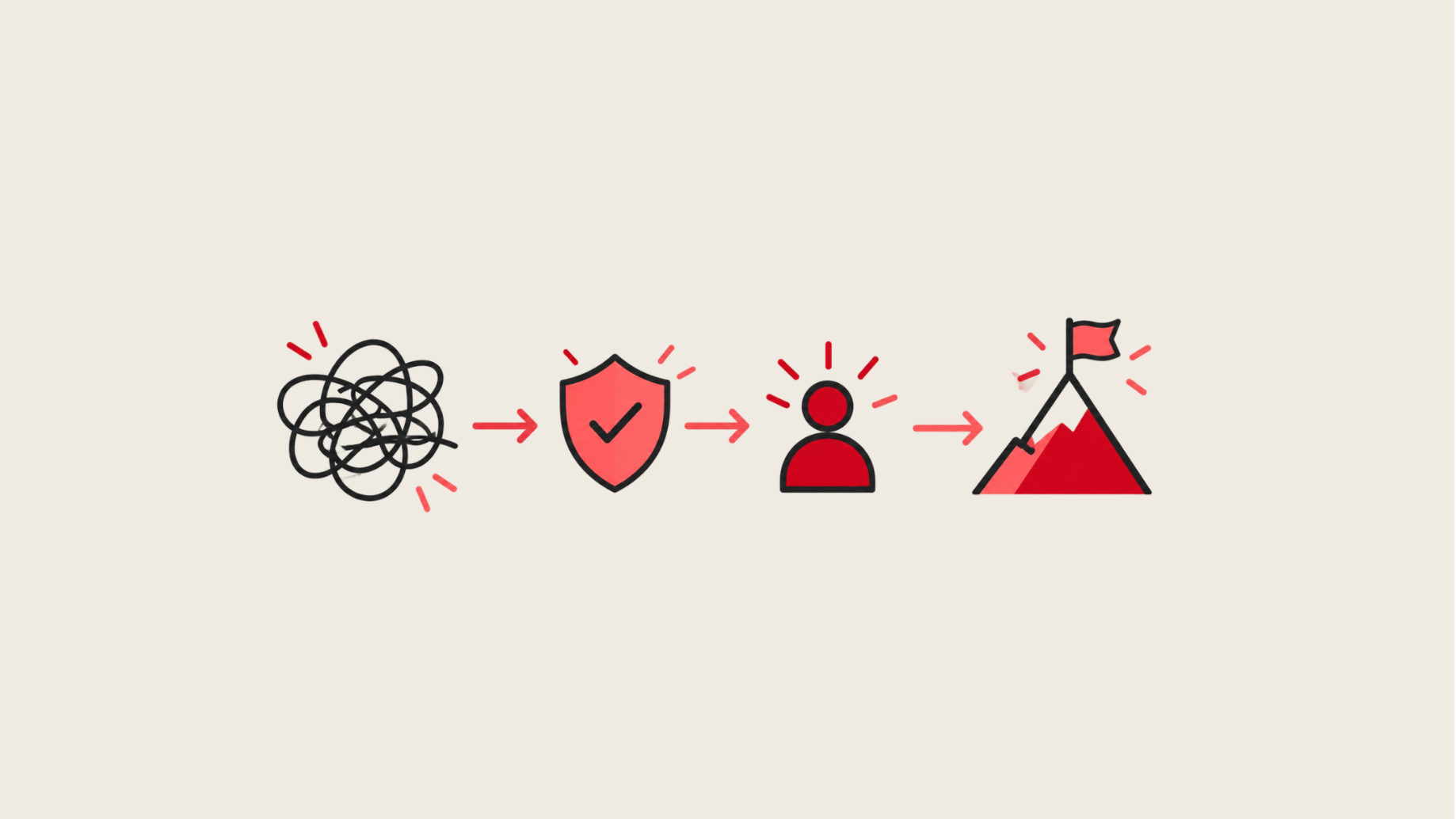
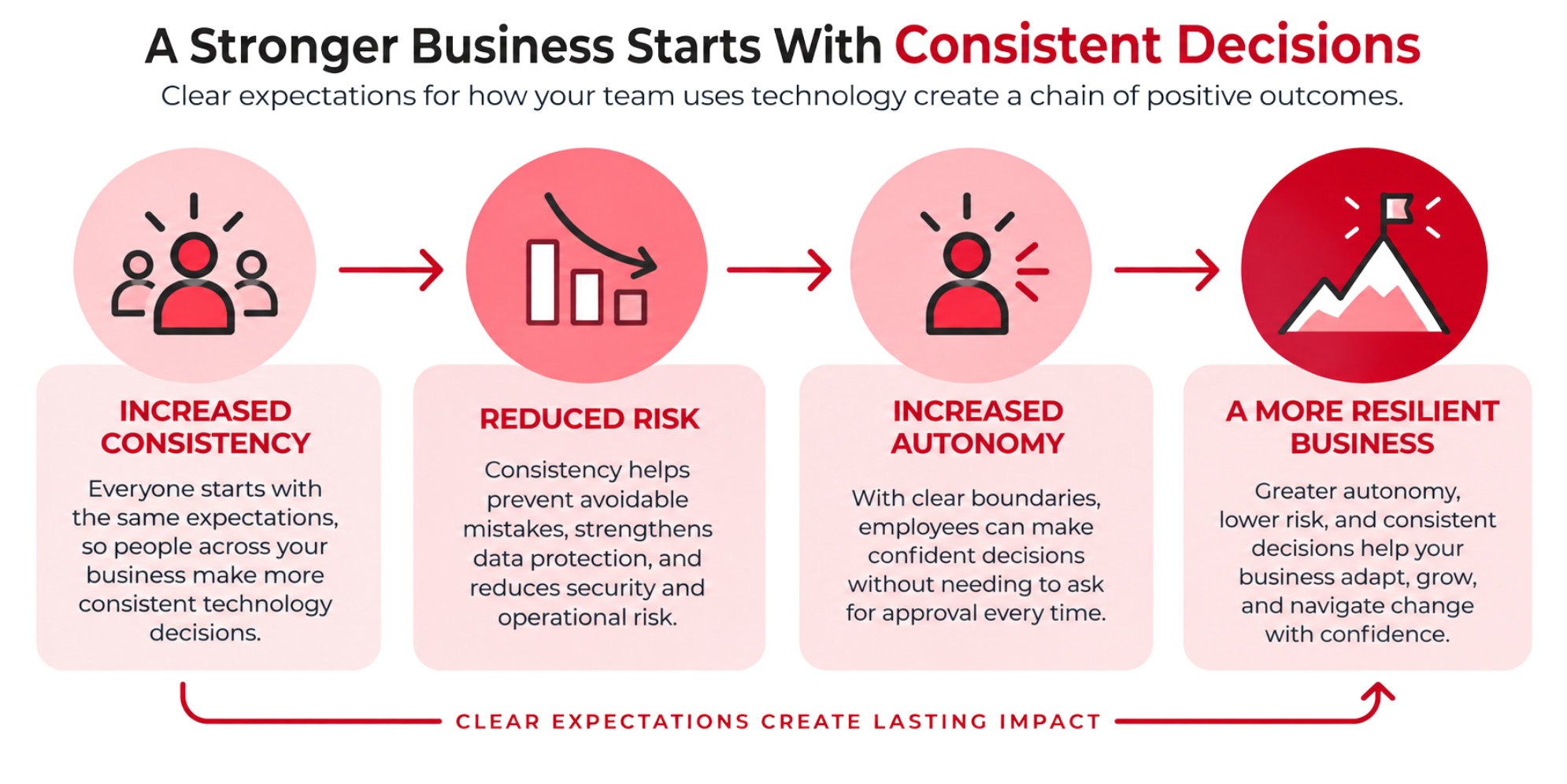
Done well, an AUP can create exactly the opposite. Greater consistency can decrease business risk, which helps support autonomy for your people and greater resilience for your business.
What are the benefits of an Acceptable Use Policy?
That might include devices, applications, company accounts, email, cloud platforms, internet access, business information, remote-work technology, and increasingly, AI and other emerging tools.
But the policy itself isn't the real value.
The value comes from what those shared expectations allow your team to do.
For a small business, some of the most important benefits of an Acceptable Use Policy include:
Creating more consistent technology decisions across teams
Giving employees greater clarity and autonomy
Reducing technology, security, and information risks
Making responsible technology adoption easier
Establishing expectations that can scale as your team grows
Reducing dependence on individual knowledge
Supporting a stronger security culture
Building greater business resilience
Let's look at what those benefits mean in practice.
1. Create more consistent decisions across teams
Imagine two employees discover the same new productivity tool.
One asks whether it's approved before connecting it to their company account.
The other creates an account immediately and uploads company information to test it.
Or two teams need to share sensitive information with an outside partner.
One uses an approved company platform.
The other uses whatever file-sharing service happens to be most convenient.
Or an employee receives an unusual email asking them to sign in to a company account.
One reports it.
Another assumes someone else will if it's important.
The problem isn't necessarily that anyone is being careless.
They may simply be operating from different expectations.
That's especially easy in a small business where processes often develop organically. One team may learn a particular way of doing something while another develops an entirely different approach.
Inconsistencies can create security gaps, make information and technology harder to manage, duplicate tools–and your business costs–and leave employees unsure about what they should do.
As the company grows, those differences can multiply. More employees, teams, devices, applications, and ways of working mean more technology decisions are being made across the business.
Over time, those inconsistencies can create security gaps, make information and technology harder to manage, duplicate tools and costs, and leave employees unsure about what they should do.
An AUP gives everyone a common framework from which to make their decisions.
Employees can understand which tools are allowed, or require vetting, how company information should be handled and stored, what decisions requires approval, what should be reported, and where to go when they have a question.
Consistency doesn't require making every decision for your team.
It just means everyone uses the same decision-making framework.
A strong Acceptable Use Policy gives people across your business a shared foundation for making technology decisions. With clear boundaries, employees can exercise judgment, adapt to different situations, and move forward with greater confidence.
Clarity creates consistency. Consistency builds confidence. And confidence gives people greater autonomy to make good decisions faster.
More policies. More rules. More approvals. More people saying no.
But a good AUP should help your team do something very different:
Make more decisions without needing to ask.
Consider an employee who wants to try a new tool.
Without clear expectations, they may have two choices. Use it and hope it's okay, or stop and ask someone for permission.
The first option is a business risk. The second is highly inefficient if they don't understand the approval process or even who to ask. Don't make your team choose between risk and efficiency.
A actionable AUP can establish clear boundaries and guardrails, as well as point to approval processes and other related procedures.
Don't make your team choose between risk and efficiency.
Maybe employees can use new tools that don't access company or customer information without first getting permission, but applications that connect to company systems require approval first.
Now the employee has a framework for making the decision.
The same principle applies to personal devices, file sharing, remote work, company accounts, AI tools, and other everyday technology decisions.
Clear expectations allow employees to understand what they can decide themselves, what isn't appropriate, and when they should ask for help.
That's not less autonomy. It's autonomy supported by clarity.
3. Reduce everyday technology and information risk
Risk doesn't have to mean a dramatic cybersecurity incident.
For a small business, technology risk often shows up in much more ordinary ways.
An employee stores a company document in a personal cloud account.
A browser extension is given access to company information without anyone evaluating it.
Someone shares login credentials because it's the fastest way to give a coworker access.
A lost personal device still has access to company email.
Customer information is entered into a tool that hasn't been approved to handle it.
An employee receives a suspicious message but doesn't know whether or where to report it.
Different teams begin using different applications for the same purpose, making information harder to manage and increasing the number of systems the company depends on—and pays for.
These aren't abstract cybersecurity risks. They can affect the confidentiality of information, availability of important systems, customer relationships, operational efficiency, and the company's ability to understand where its information lives.
It can also increase operating expenses. Duplicate software, unnecessary subscriptions, and overlapping tools can quietly add costs without adding meaningful value.
Financial responsibility is an important part of business resilience, and an AUP can help teams make technology decisions that protect not only company information, but company resources as well.
An AUP can't eliminate all risks for small businesses.
But it can reduce unnecessary uncertainty around common ones.
Risk has a price tag.
Technology risk isn’t limited to security.
When teams make purchasing decisions independently, small expenses can quietly—and avoidably—add up.
A resilient business pays attention to where its technology dollars are going and whether they’re creating value. Clear expectations around technology adoption and purchasing help teams make thoughtful decisions without taking away their ability to move quickly.
Good technology governance protects more than your information. It protects your resources, too.
4. Make responsible technology adoption easier
Yes, easier.
Technology will continue to evolve, and that's a good thing.
New tools can help small businesses automate work, improve customer experiences, collaborate more effectively, analyze information, reduce manual processes, and accomplish more with limited resources.
An AUP shouldn't stand in the way of that progress.
It should help your business embrace it thoughtfully.
Rather than attempting to maintain an exhaustive list of every tool employees can and cannot use, a strong policy can establish principles for evaluating new technology.
For example:
Does the tool need access to company or customer information?
Will it connect to an existing company account?
Who should review it before it's adopted?
What information can employees share with it?
Does the business already have an approved tool that serves the same purpose?
Are there security, privacy, contractual, or operational considerations the team should understand?
Now your employees have a framework they can apply even when the technology itself is new.
Eventually, "everyone just knows" stops being a reliable process. An Acceptable Use Policy helps turn informal knowledge into shared organizational knowledge.
That's increasingly important with AI, where new applications and capabilities can emerge faster than businesses can write policies about each individual tool.
AI tools are evolving quickly, and their use can introduce unique risks around company and customer information, privacy, accuracy, intellectual property, and security. That’s why many businesses are creating AI-specific Acceptable Use Policies to give their teams clear guidance for adopting and using AI responsibly.
The goal isn’t to slow AI adoption. It’s to help your team move with it. Clear expectations can give employees the confidence to explore and embrace AI while reducing unnecessary risk and protecting your business, your information, and your customers.
Good policies don't prevent innovation. They create boundaries that allow innovation to happen more confidently.
5. Create clear expectations as your business grows
Small teams can operate on shared knowledge remarkably well.
Everyone sits near each other. People ask questions. The owner knows which applications are used. A longtime employee knows where documents belong. Someone knows who should have access to what.
Then the company grows.
Five employees become 15.
One location becomes three.
A remote employee joins.
New managers are hired.
Contractors need system access.
Teams begin choosing specialized software.
People who weren't there when the original decisions were made have to figure out how things work.
Eventually, "everyone just knows" stops being a reliable process.
An Acceptable Use Policy helps turn informal knowledge into shared organizational knowledge.
Eventually, "everyone just knows" stops being a reliable process. An Acceptable Use Policy helps turn informal knowledge into shared organizational knowledge.
New employees don't have to learn technology expectations through trial and error.
Managers don't have to create their own rules.
Different departments aren't left to develop completely different approaches.
The business creates a foundation that supports the team as it scales, pivots, or grows.
6. Reduce dependence on individual team members
Imagine one person in your company knows the answers to every technology question.
Which applications are approved?
Can someone use a personal computer?
What happens if a phone is lost?
Can we connect this application to our CRM?
Just as Bill. Or Susan. Or Alex.
People who step into leadership roles, regardless of their title, are incredibly valuable, particularly in small and midsized businesses. They’re often the people others turn to when a decision needs to be made or a question needs to be answered.
But without clear, shared guidance, they can also unintentionally become a bottleneck.
Shared guidelines create shared capability. And that's an important part of resilience.
If they're unavailable, other people may be forced to guess.
An AUP helps move important knowledge out of individual people's heads and into the business.
It doesn't eliminate the need for judgment or expertise. There will always be situations that require a conversation.
But routine decisions don't need to depend on finding the one person who knows the answer.
Shared guidelines create shared capability.
And that's an important part of resilience.
7. Help build a security-first culture
A policy can establish guidelines.
Culture determines what happens when no one is looking.
When employees understand why technology expectations exist, know where to ask questions, feel comfortable reporting mistakes, and see leaders following the same expectations, security starts becoming part of everyday decision-making.
Security starts becoming part of everyday decision-making.
Instead of security being something handled exclusively by an IT provider or discussed during annual training, it becomes part of ordinary questions:
Is it safe to use this application?
Where should this information be stored?
Who needs access to this data and why?
Is this okay to share with my team member? With a customer?
Something doesn't look right. Should I report it? And to whom?
Those small decisions matter.
8. Build a more resilient business
Ultimately, many of these Acceptable Use Policy benefits lead to something bigger:
Resilience.
A resilient business isn't one where nothing ever changes or goes wrong.
It's one that can adapt. Pivot quickly. Thrive under multiple circumstances.
People know what's expected.
Important knowledge isn't held by one person.
Teams can make decisions without unnecessary bottlenecks.
New technology can be evaluated thoughtfully.
Employees know what to do when something unusual happens.
Processes can continue even when a key person isn't available.
And, when the business changes, its policies change with it.
That's why an AUP isn't simply a list of technology rules.
It's part of the operating foundation that helps your team make secure, effective, and consistent decisions about technology.
An Acceptable Use Policy shouldn't stop technology from evolving
There's an important balance here.
Your AUP should create consistency without creating rigidity.
Your technology environment won't stay the same for long. As new tools, systems, and ways of working emerge, your policies need to evolve with them. An outdated technology policy can't provide useful guidance for the decisions your team is making today.
Review your policy regularly, with a cadence that reflects how your team uses and adopts technology.
And don't assume every change represents a new risk that should be prevented.
Technology evolution is a natural part of growth, and when managed thoughtfully, it can strengthen business resilience.
The goal isn't to keep your technology environment exactly the same.
It's to create a consistent way of making good decisions as that environment changes.
From Acceptable Use Policy benefits to best practices
Understanding the value of an AUP is one thing.
Creating one that actually delivers that value is another.
A policy that's too vague won't provide enough guidance.
A policy that's too restrictive may get in the way of work.
And a generic template that doesn't reflect how your business actually uses technology can quickly become another document no one references.
That's why how you build your policy matters.
Our Acceptable Use Policy Best Practices for Small Businesses guide walks through how to create practical expectations around devices, applications, company information, remote work, new technology, reporting, policy reviews, and more.
One of the most valuable things a small business can give its people is clarity.
Not a rule for every situation.
Not an approval process for every decision.
Not a policy so restrictive that employees are afraid to try something new.
Clarity.
An effective Acceptable Use Policy establishes a common foundation so people across your business understand how technology should be used, where the boundaries are, and when they need to ask for help.
That creates greater consistency across teams.
It reduces avoidable risk.
It makes responsible technology adoption easier.
It reduces dependence on individual people.
And it gives employees more confidence to make decisions on their own.
Consistency is a key building block for creating confidence.
When everyone starts with the same expectations, people don't need identical roles, expertise, or experiences to make good decisions.
Give your team clear boundaries. Give them room to exercise judgment. Give them somewhere to turn when they're unsure.
Then trust them to move forward.
That's how policies stop being paperwork and start becoming part of how a resilient business operates.
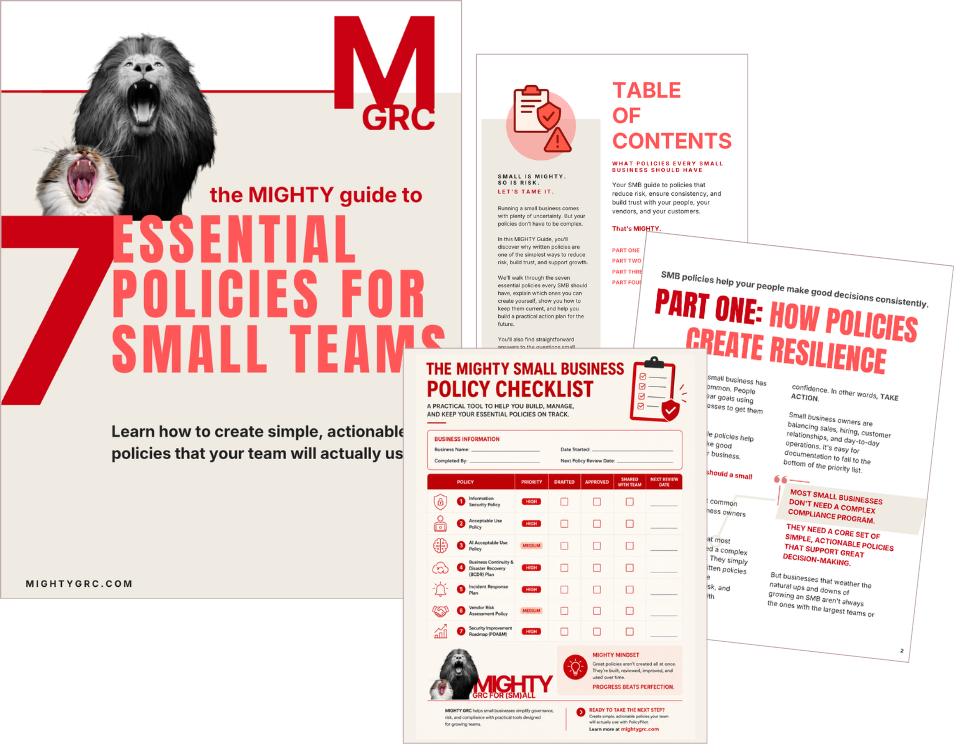
Get your free MIGHTY Guide to writing your first small business Acceptable Use Policy, and take the first steps toward building a practical policy program that includes Information Security, AI, Business Continuity, and more.
Start with an Acceptable Use Policy. Build a stronger business.
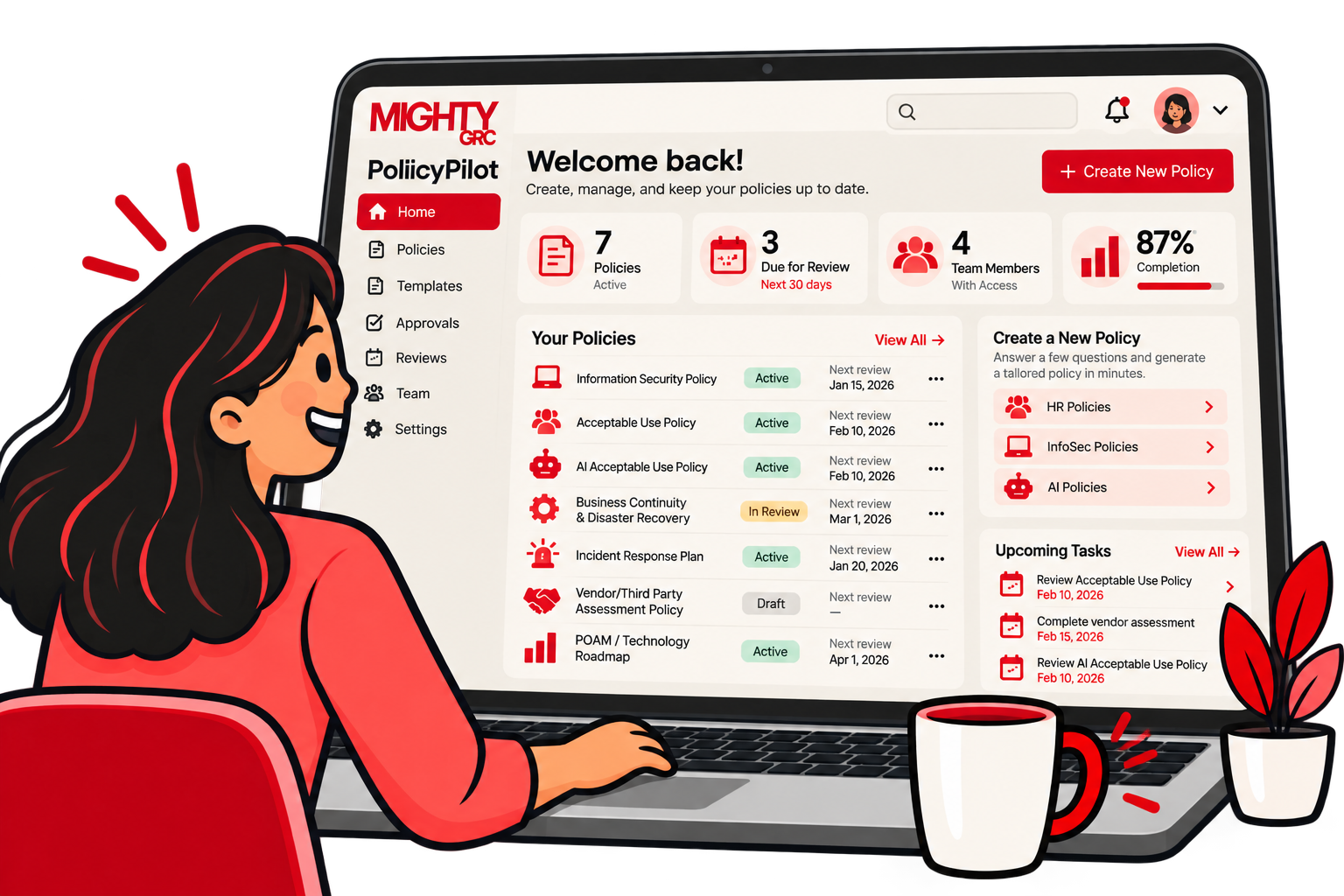
PolicyPilot by MIGHTY GRC helps small businesses turn complex policy requirements into clear, tailored policies built around how their business actually operates.
Creating an effective Acceptable Use Policy shouldn't require starting from a blank page or turning a generic template into another document that gets filed away instead of put into practice.
Answer a few straightforward questions, and in minutes you can:
Customize your Acceptable Use Policy for your real world business.
Manage policy reviews and approvals in one place.
Use automated reminders to keep your Acceptable Use Policy current.
Because having a policy isn't the same as putting it to work.
Your policies should be simple. They should be actionable.
And they should actually get used.
Explore PolicyPilot today and start building your Acceptable Use Policy in minutes.
Thank you from the MIGHTY team. We are dedicated to offering learning resources for small and midsized businesses that are supportive, actionable, and will actually get used.
This article is provided for educational and informational purposes only. It is intended to help small businesses better understand governance, risk, compliance, and policy management, but it is not legal, financial, cybersecurity, insurance, or other professional advice.
Use this content as a starting point for building a stronger, more resilient business—not as a substitute for professional advice tailored to your specific needs.


 An Acceptable Use Policy doesn't have to mean more rules or less autonomy.
 Let's look at what those benefits mean in practice.
 AI tools are evolving quickly, and their use can introduce unique risks around company and customer information, privacy, accuracy, intellectual property, and security. That’s why many businesses are