InfoSec PolicySmall Business PoliciesDIY Policy Programs
How to Create an Information Security Policy for Your Small Business
Michael Wallace, MIGHTY CoFounder & CEO
Every business has information worth protecting.
Customer records. Employee information. Financial data. Passwords. Contracts. Emails. Business plans. The systems and software your team relies on every day.
But protecting that information isn't just an IT responsibility. Every time someone shares a file, downloads an application, logs into a system, or gives a coworker access to information, they're making a security decision.
That's where an Information Security Policy comes in.
The goal of a good Information Security Policy is to give your team clear, practical guidance for making those decisions consistently. And creating one doesn't have to mean building an enterprise-sized security program or writing a 50-page document no one will read.
The goal of a good Information Security Policy is to give your team clear, practical guidance for making decisions consistently.
In this article, we'll walk you through:
Why your small business actually does need an InfoSec Policy
How to create an Information Security Policy in 7 steps
The 8 core cybersecurity requirements your policy must have
How to make sure your policy will be useful now, and as your business grows
You won't just be creating more paperwork.
You'll be creating something your team can actually use.
It creates a shared set of rules for questions like:
Who should have access to company systems?
How should sensitive information be stored and shared?
What security practices are employees expected to follow?
How should passwords and multi-factor authentication be handled?
What happens to system access when someone leaves the company?
What should an employee do if they notice something suspicious?
Your Information Security Policy doesn't need to account for every security scenario your business could ever encounter.
An Information Security Policy is one of the first policies we recommend because it creates a foundation for protecting sensitive information and, critically, for helping employees make consistent decisions.
It should establish a strong enough foundation that your team knows what's expected and can make good decisions when situations arise.
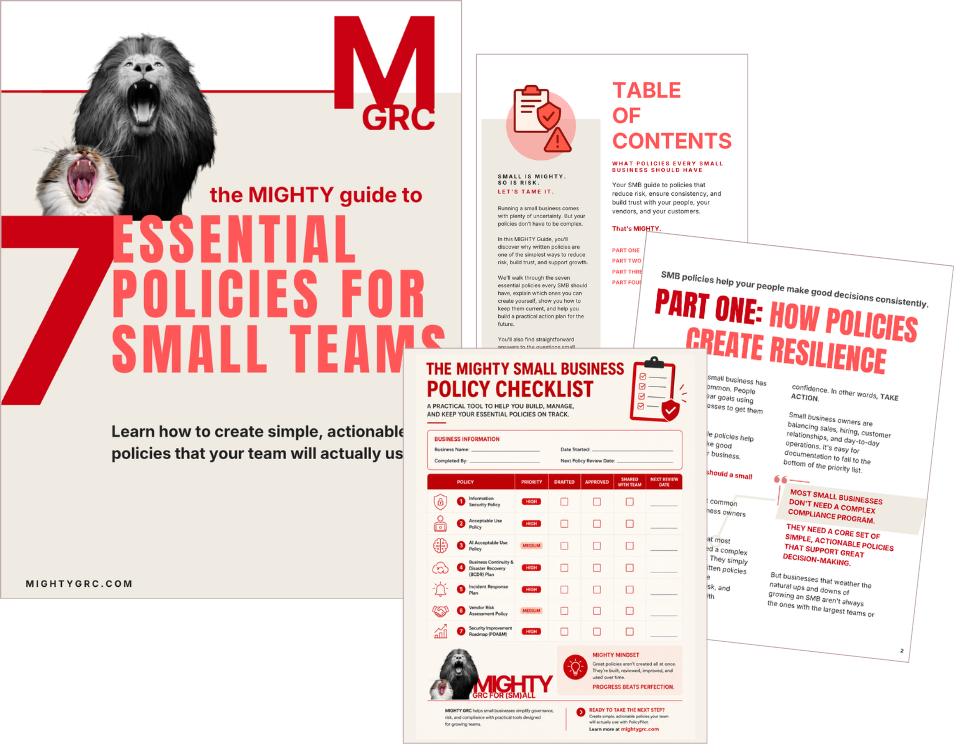
If you're still figuring out which policies your business needs, start with our MIGHTY Guide to the 7 Essential Policies Every Small Business Should Have. An Information Security Policy is one of the first policies we recommend because it creates a foundation for protecting sensitive information and helping employees make consistent decisions.
Why does a small business need an Information Security Policy?
Small businesses make security decisions all day long, even when no one thinks of them as "security decisions."
Someone sends a customer file to a coworker.
A new employee needs access to your accounting software.
A team member wants to install a new application.
An employee receives an email asking them to reset a password.
Someone leaves the company and their accounts need to be disabled.
Without established expectations, people tend to make these decisions based on experience, assumptions, or convenience. The MIGHTY Guide to Small Business Policies identifies that the accumulation of small, inconsistent decisions is one of the biggest risks of operating without a written Information Security Policy.
The accumulation of small, inconsistent decisions is one of the biggest risks of operating without a written Information Security Policy.
A policy replaces some of that uncertainty with consistency.
And as your business grows, having documented security practices can also make it easier to respond to questions from customers, partners, cyber insurance providers, and others who want to understand how you protect information.
But there's an important distinction:
Having a policy isn't the goal. Creating better, more consistent security practices is.
Let's build an InfoSec Policy with that in mind.
Clarity creates autonomy.
Small businesses need people who can make good decisions without waiting for someone else to tell them what to do.
A strong Information Security Policy gives your team clear boundaries and expectations so they can act independently, make consistent decisions, and feel confident in their roles. Instead of relying on one person to hold all the answers, your business creates shared knowledge that everyone can use.
That autonomy matters for resilience, too. When people understand how your business expects information to be protected, good decisions can continue to happen even when a manager is unavailable, a key employee is out, or something unexpected occurs.
The goal isn't to control every decision. It's to give your team the clarity and confidence to make the right ones.
How to create an Information Security Policy in 7 steps
You don't need to begin with legal language, a compliance framework, or a giant policy template.
Start with your business.
Step 1: Identify what you're protecting
Before deciding how information should be protected, you need a basic understanding of what you're protecting.
Don't overcomplicate this exercise. You don't necessarily need a sophisticated data inventory to create your first policy.
Start by identifying the information and systems that matter most to your business.
A MIGHTY Tip for SMBs
Progress beats perfection.
Don't try to catalog every file your company has ever created.
Start with the information and systems that are sensitive, important, or essential to running your business. You can improve your inventory over time.
That might include customer information, employee records, financial information, contracts and intellectual property, email, cloud storage, accounting or payroll software, customer relationship management systems, and other applications your business depends on.
Then ask a few practical questions.
Where does this information live?
Who needs access to it?
Which systems would create the biggest problem if they became unavailable or compromised?
What information would cause the greatest harm if it were accidentally shared with the wrong person?
Your Business Goal
Connect security requirements to your actual business instead of writing generic rules.
Step 2: Define the purpose and scope of your policy
Next, establish what the policy is meant to accomplish and who it applies to.
Your purpose can be relatively straightforward: protecting company and customer information, establishing consistent security expectations, and reducing unnecessary risk.
You need people to understand: This applies to me, and I know what I'm responsible for.
Then define the scope.
Does the policy apply to employees? Contractors? Temporary workers? Everyone who accesses company systems or information?
Does it cover company-owned devices only, or personal devices used for work as well?
Does it apply when employees work remotely?
Clarity matters here. A policy that's vague about who or what it applies to becomes difficult to follow.
Your Business Goal
You don't need paragraphs of legal language.
You need people to understand: This applies to me, and I know what I'm responsible for.
Step 3: Assign security roles and responsibilities
Small businesses rarely have a large cybersecurity department.
Many don't have a dedicated security employee at all.
That's okay.
What's important is making it clear who is responsible for what.
Who approves access to sensitive systems?
Who creates and removes employee accounts?
Who approves new software?
Who should employees contact if they receive a suspicious email?
Who coordinates the response if a security incident occurs?
Who owns the Information Security Policy and makes sure it's reviewed?
One person may perform several of these roles. Some responsibilities may belong to an outsourced IT provider or MSP.
Your Business Goal
The goal isn't to create a complicated organizational structure.
It's to prevent the dangerous phrase: "I thought someone else was handling that."
Step 4: Establish your core cybersecurity requirements
The exact requirements will vary by business, but this is where you address areas such as:
Access control. Who gets access to systems and information, how access is approved, and when it should be removed.
Passwords and authentication. Expectations for passwords and where multi-factor authentication should be used.
Data handling. How sensitive information should be stored, accessed, transmitted, and shared.
Devices. Expectations for company-owned and, where applicable, personally owned devices used for work.
Software. Who can install or approve applications and what employees should do before introducing new technology.
Remote work. Security expectations when employees access company systems outside the office.
Security awareness and training. Employee responsibilities for recognizing and avoiding common security threats.
Incident reporting. How employees should report suspicious emails, lost devices, unusual account activity, or other potential security issues.
Your Business Goal
Your goal here isn't to include every cybersecurity control imaginable. It's to establish the security practices that matter to your organization.
8 core cybersecurity essentials your InfoSec Policy should address
You don't need a rule for every possible security scenario.
Focus on the decisions your team makes most often and the situations that could create the greatest risk if handled inconsistently.
Clear expectations across the eight areas highlighted in the table below give people a practical foundation for making good security decisions independently and confidently.
Security Area
The Question Your Policy Should Answer
What Clear Guidance Looks Like for Your Team
Access Control
Who should have access to our systems and information?
Define how access is approved, limited by role, reviewed, and removed when no longer needed.
Passwords & Authentication
How do we protect employee accounts?
Establish expectations for strong passwords, password management, and where multi-factor authentication (MFA) is required.
Data Handling
How should sensitive information be protected?
Explain where information can be stored, who can access it, and how it should be shared or transmitted.
Devices
How should employees protect the devices they use for work?
Set expectations for company-owned devices and, if allowed, personal devices used to access business information.
Software
Who decides which applications are safe to use?
Define how new software is requested, reviewed, approved, and installed before it enters your business environment.
Remote Work
What changes when employees work outside the office?
What does every employee need to know about security?
Give employees practical guidance for recognizing phishing, protecting information, and avoiding common threats.
Incident Reporting
What should someone do when something doesn't look right?
Make it clear what should be reported, who should be notified, and how quickly employees should raise a concern.
Save and share this infographic with your team!
Step 5: Make sure your InfoSec Policy reflects reality
This is one of the most important steps, and one of the easiest to overlook.
Your policy should describe how your business actually operates.
Imagine a policy says:
Employees must store all company information in approved company systems.
Sounds reasonable.
But what if no one has defined which systems are approved?
Or your policy requires multi-factor authentication on every application, but several of your applications don't support it?
Or it says only IT can install software, but your company doesn't have an IT department?
You didn't write an actionable Information Security Policy for your team. You wrote a document describing an imaginary business.
You didn't write an actionable Information Security Policy for your team. You wrote a document describing an imaginary business.
Before finalizing each requirement, ask: Can our team actually do this today?
If the answer is no, you have two choices:
Adjust the policy, or
Make an operational improvement that allows you to meet the requirement.
Both are useful outcomes.
In fact, writing your policy can reveal gaps you didn't know existed. Those gaps can become part of a Security Improvement Roadmap, allowing you to prioritize improvements rather than pretending everything is already perfect.
Your Business Goal
Honesty. Document where you are, identify where you want to improve, and keep moving forward. That's how small becomes MIGHTY.
Step 6: Make it actionable for employees
A technically accurate policy can still be a bad policy.
Why?
Because if employees don't understand it, can't find it, or aren't sure what they're supposed to do, it won't change behavior.
Read your draft from the perspective of an employee who isn't an IT or cybersecurity expert.
Could they understand it?
Could they tell what they're expected to do?
Would they know who to contact with a question?
Would they know what to do if something went wrong?
Look for vague statements such as:
Users shall implement appropriate safeguards for confidential information.
What does appropriate mean? Which information is confidential? What does the employee actually need to do?
Wherever possible, replace ambiguity with clear expectations, including specific actions to take or avoid.
Replace ambiguity with clear expectations.
That doesn't mean your policy needs to become a step-by-step instruction manual. Procedures can explain exactly how to perform particular tasks, while your policy establishes what the business expects.
Let's use multi-factor authentication as an example. The policy can require it, while a supporting procedure explains how to enable it.
The two should work together.
Your Business Goal
Clarity and precision in language and in your expectations of your team.
Step 7: Approve it, share it, and put it to work
You wrote the policy.
Great.
You are not done.
Employees need to know your Information Security Policy exists, understand the expectations that apply to them, and know where to find it.
Depending on your business, that might mean introducing the policy during a team meeting, including it in onboarding, providing related cybersecurity awareness and training, requiring employees to acknowledge they have read the policy, or keeping it in an easily accessible policy library.
Employees need to know your InfoSec Policy exists... And then you need to schedule its next review.
You should also revisit it whenever meaningful changes occur, such as:
Adopting new technology
Hiring employees
Switching IT providers
Renewing cyber insurance, or
Responding to a security incident
Your Business Goal
An Information Security Policy that can grow with your business, with your technology, and with your team.
What should an InfoSec Policy include?
There's no universal table of contents that's right for every small business.
Your policy should reflect your technology, people, information, risks, and any requirements that apply to your organization.
A 10-page policy that accurately reflects your business and helps people make decisions is far more valuable than a 40-page generic template.
That said, a small business Information Security Policy will commonly address areas such as:
Purpose and scope
Roles and responsibilities
Access control
Passwords and authentication
Multi-factor authentication
Sensitive information and data handling
Company devices
Personal devices, if permitted
Software and application use
Remote access and remote work
Security updates and system maintenance
Backups, where applicable
Security awareness and employee responsibilities
Reporting suspicious activity
Account provisioning and termination
Policy exceptions
Enforcement
Policy ownership, approval, and review
Don't treat that as a checklist where more sections automatically equal a better policy.
A 10-page policy that accurately reflects your business and helps people make decisions is far more valuable than a 40-page generic template filled with requirements your organization doesn't understand or follow.
Common Information Security Policy mistakes that small businesses make
Mistake #1: Starting with a generic template and just changing the company name
Templates can be incredibly useful.
But a template should be a starting point, not the finished product.
Your MIGHTY Guide makes the same distinction: templates work well as a foundation, but they need to be customized to your technology, processes, and team.
Mistake #2: Making the policy too technical
Your employees shouldn't need a cybersecurity certification to understand what's expected of them.
Use plain language whenever possible. Explain technical terms when they're necessary. Keep the focus on decisions and actions.
Mistake #3: Writing security requirements you don't actually follow
This can happen easily when policies are copied from templates, generated without enough business context, or inherited from another organization.
If your policy says you perform a particular security activity, make sure you actually do it.
If your policy says you perform a particular security activity, make sure you actually do it.
Mistake #4: Trying to cover every possible risk
Your first Information Security Policy does not need to solve potential cybersecurity needs a decade into the future.
Focus on the areas that matter most to your organization today. Then, improve the policy as your security program matures.
Mistake #5: Treating approval as the finish line
A policy sitting unnoticed in a folder isn't accomplishing much.
Communicate it.
Make it accessible.
Incorporate it into onboarding and relevant training.
Review it.
Update it.
The best policy is one that becomes part of how your business operates.
How often should you review your Information Security Policy?
For most small businesses, at least annually is a practical baseline.
But don't let the calendar be the only trigger.
Review your policy when something meaningful changes in your business.
Ask yourself: Does this policy still describe how our business operates today? If it doesn't, update it.
You might introduce a new technology platform, begin collecting a new type of customer information, expand remote work, hire significantly, change IT providers, experience a security incident, or encounter new customer, insurance, contractual, or compliance expectations.
Ask yourself: Does this policy still describe how our business operates today?
If it doesn't, update it.
Your business evolves.
Your policies should, too.
Every policy review is an opportunity to make your business stronger. As your team, technology, customers, and risks change, revisit your policies to make sure they still reflect how your business actually operates.
Review. Refine. Reinforce.
Each time you do, you create clearer expectations, more consistent decisions, and a more resilient business. Because the best policies grow with you.
You don't necessarily need to hire a consultant to create your first Information Security Policy.
A trusted template can give you structure. Your team can provide the business knowledge. A SaaG (software as a guide) can help you turn that information into clear policies and documentation, and can automate updates and reviews.
The key is customization.
Your policy needs to reflect your actual systems, people, processes, and security practices.
There are also situations where outside expertise can be particularly valuable. Businesses handling sensitive customer information, operating in regulated industries, applying for cyber insurance, or working toward a compliance framework are cases where having someone with security expertise review the policy may be worthwhile.
The strongest policies bring security expertise and institutional knowledge together into one actionable document.
Think of expert review as another tool available to you, not evidence that you can't do the work yourself.
You know your business.
The expert brings specialized security or compliance knowledge.
The strongest policies bring security expertise and institutional knowledge together into one actionable document.
Information Security Policy creation: templates vs. starting from scratch
You certainly can open a blank document and start typing.
You probably don't need to.
A well-designed Information Security Policy template can help you identify topics you might otherwise overlook and give your policy a logical structure.
The important question isn't:
"Should I use a template?"
It's:
"How do I turn this template into our policy?"
That means evaluating every section against your actual business.
Does this requirement apply to us?
Do we actually operate this way?
Who owns this responsibility?
Would an employee understand what this means?
Is there anything unique about our customers, data, technology, or operations that needs to be addressed?
Your finished document shouldn't sound like it belongs to a small business.
It should sound like it belongs to your small business.
The MIGHTY Mindset for resilient small businesses
Creating an Information Security Policy isn't about proving that your business has security completely figured out.
No business does.
Strong security isn't built by writing the perfect policy once. It's built through the decisions your team makes every day.
It's about creating a shared foundation for your team to help ensure better decision making.
Start with what matters most.
Document the expectations your team needs today.
Put those expectations into practice.
Then review, learn, and improve.
Because strong security isn't built by writing the perfect policy once.
It's built through the decisions your team makes every day.
Not sure where to start?
The Mighty Guide to SMB Policies
Get your free MIGHTY Guide to writing your first small business Information Security Policy, and take the first steps toward building a practical policy program that includes Acceptable Use, AI, Business Continuity, and more.
Start with an InfoSec Policy. Build a stronger business.
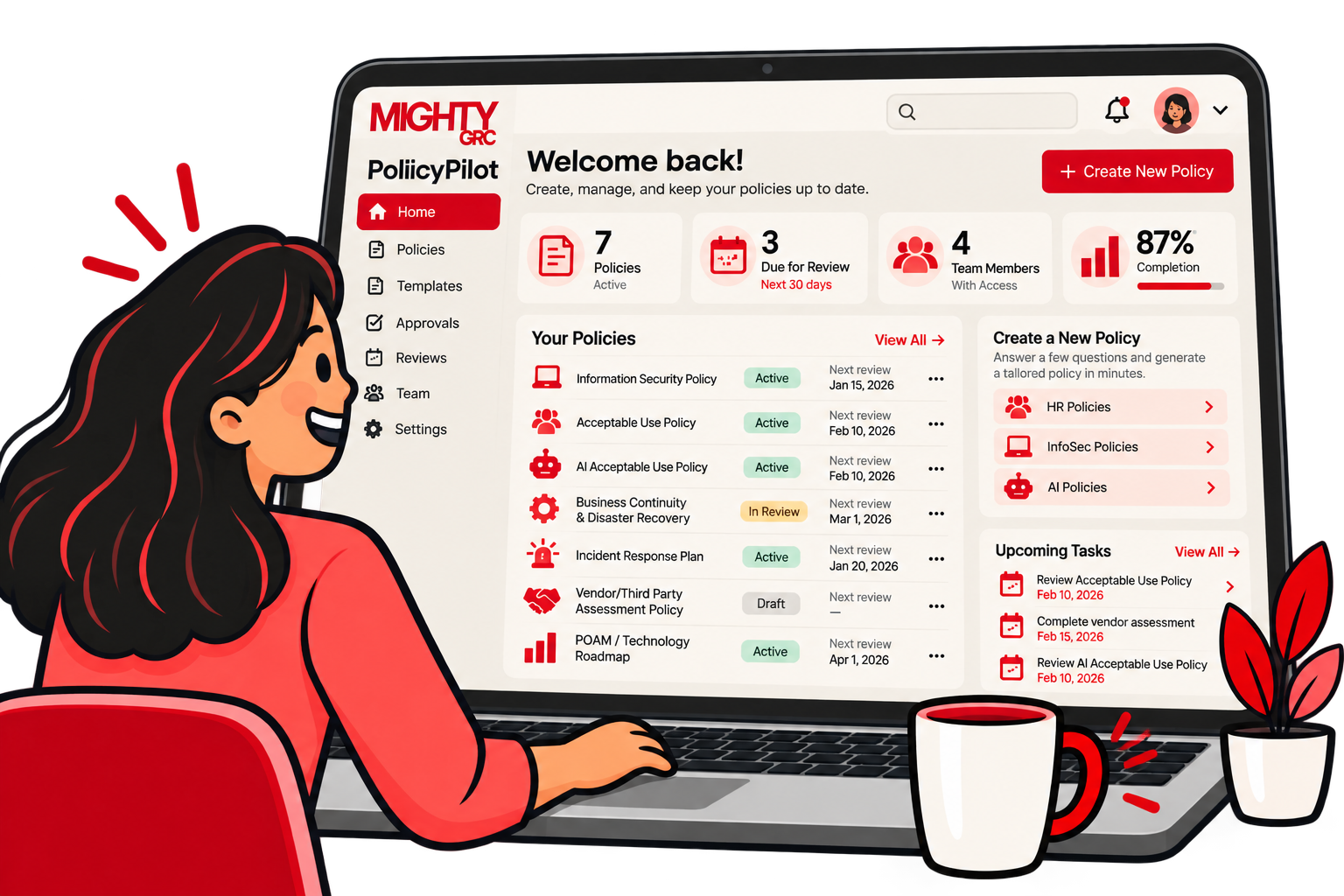
PolicyPilot by MIGHTY GRC helps small businesses turn complex policy requirements into clear, tailored policies built around how their business actually operates.
Creating an effective Information Security Policy shouldn't require weeks of research, a stack of generic templates, or an enterprise-sized compliance team.
Answer a few straightforward questions, and in minutes you can:
Customize your InfoSec Policy for your real world business.
Manage policy reviews and approvals in one place.
Use automated reminders to keep your InfoSec Policy current.
Because having a policy isn't the same as putting it to work.
Your policies should be simple. They should be actionable.
And they should actually get used.
Explore PolicyPilot today and start building your InfoSec Policy in minutes.
Thank you from the MIGHTY team. We are dedicated to offering learning resources for small and midsized businesses that are supportive, actionable, and will actually get used.
This article is provided for educational and informational purposes only. It is intended to help small businesses better understand governance, risk, compliance, and policy management, but it is not legal, financial, cybersecurity, insurance, or other professional advice.
Use this content as a starting point for building a stronger, more resilient business—not as a substitute for professional advice tailored to your specific needs.

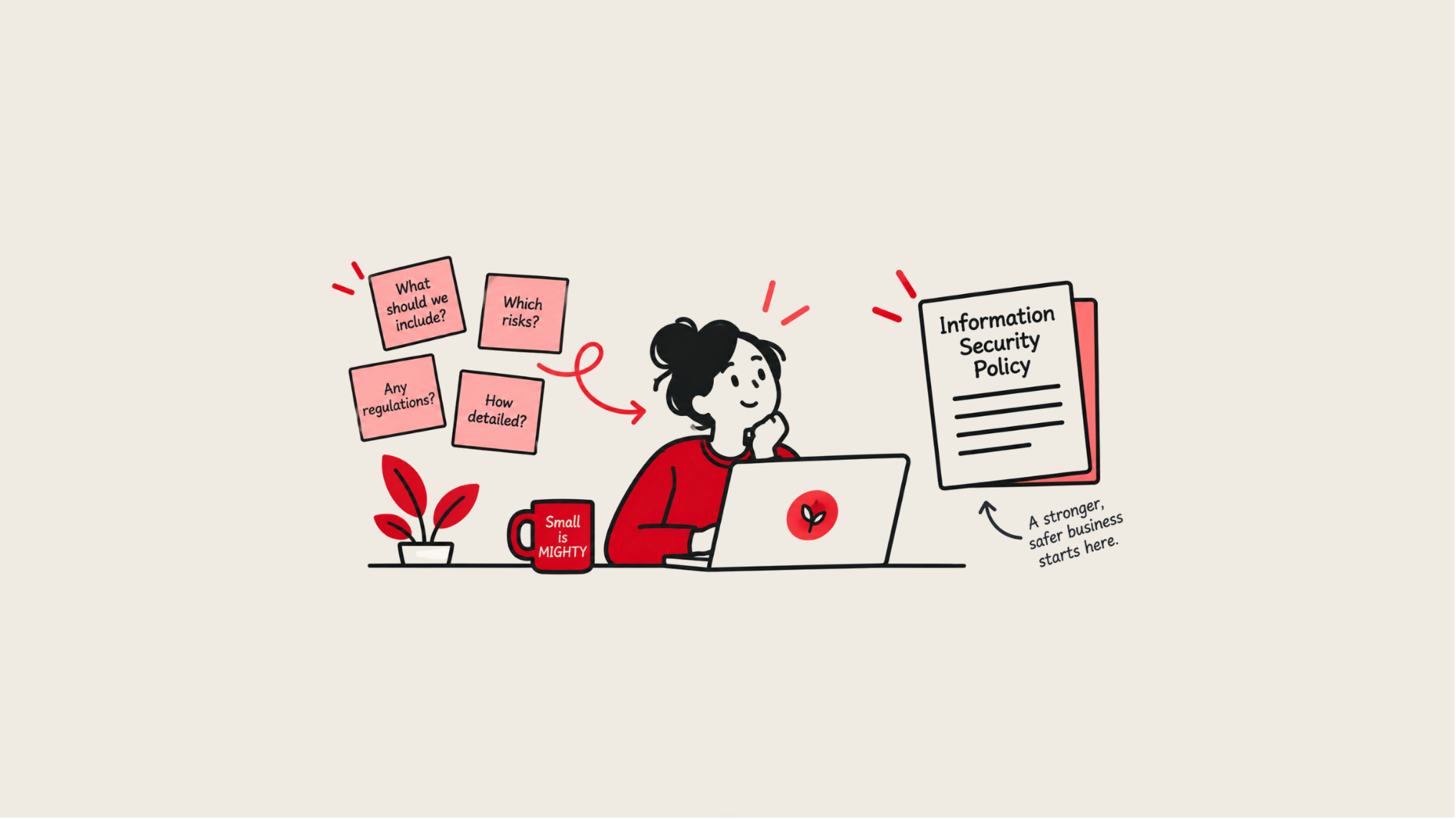

 The goal of a good Information Security Policy is to give your team clear, practical guidance for making decisions consistently.
 A MIGHTY Tip for SMBs
 Your Business Goal
 Access control. Who gets access to systems and information, how access is approved, and when it should be removed.
 Passwords and authentication. Expectations for passwords and where multi-factor authentication should be used.
 Data handling. How sensitive information should be stored, accessed, transmitted, and shared.
 Devices. Expectations for company-owned and, where applicable, personally owned devices used for work.
 Software. Who can install or approve applications and what employees should do before introducing new technology.
 Remote work. Security expectations when employees access company systems outside the office.
 Security awareness and training. Employee responsibilities for recognizing and avoiding common security threats.
 Incident reporting. How employees should report suspicious emails, lost devices, unusual account activity, or other potential security issues.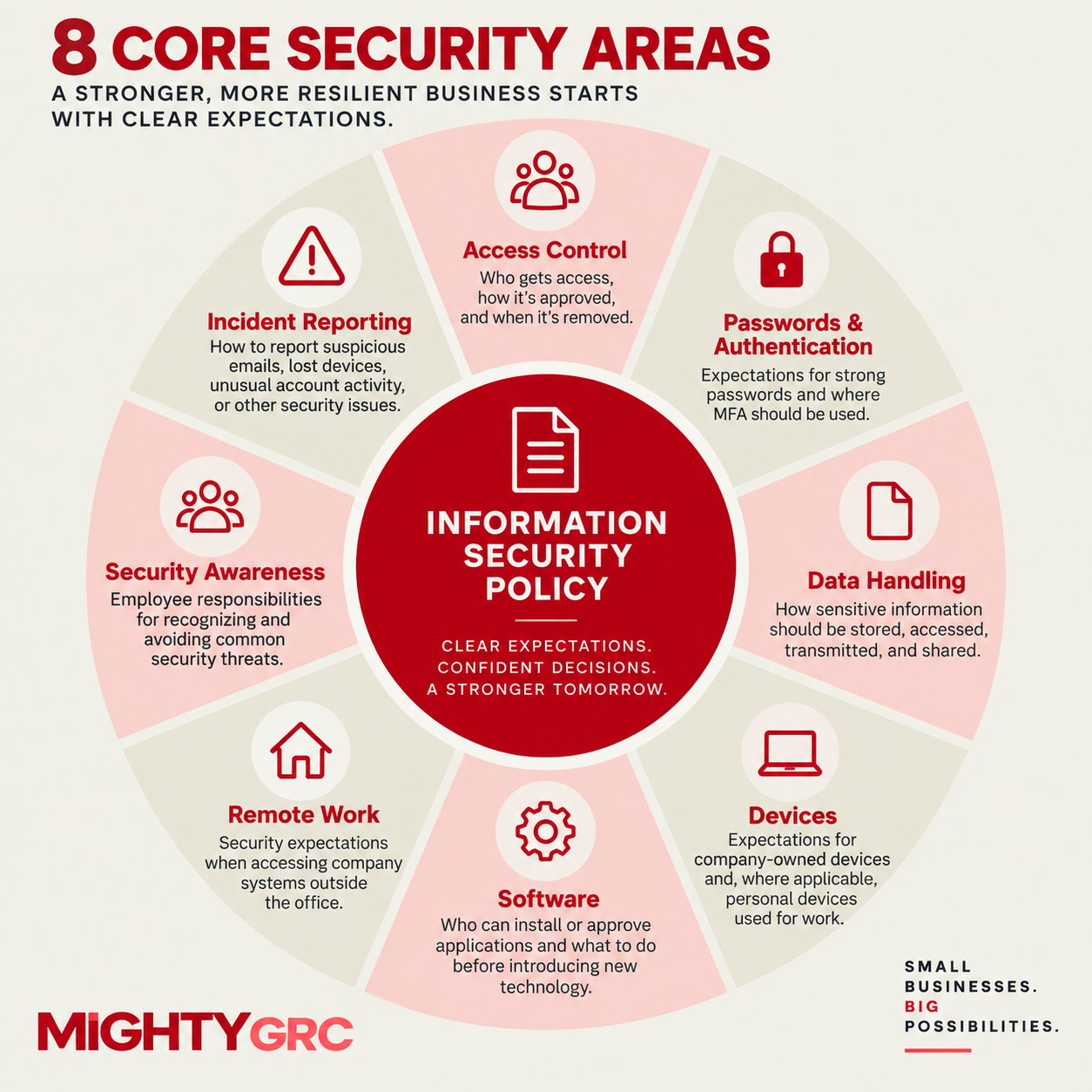

 Your Business Goal