Business ResilienceCybersecurity for Small BusinessRisk Mitigation
How to Build a Cybersecurity Culture: A Practical Guide for Small Business
Michael Wallace, MIGHTY CoFounder & CEO
Cybersecurity isn't just an IT responsibility. It's a business responsibility, and everyone has a role to play.
When small business owners think about cybersecurity, technology often comes to mind first. Firewalls, antivirus software, password managers, and other security tools are important. But even the best technology can't eliminate every risk.
Your employees make decisions every day that affect your business's security. They open emails, share information, access business systems, work with vendors, and handle sensitive customer data.
Those everyday decisions can either strengthen your business's security or introduce unnecessary risk.
That's why learning how to build a cybersecurity culture is one of the most valuable steps a small business can take to protect itself.
You don't need a dedicated cybersecurity team, an enterprise-sized budget, or complicated processes to get started.
And the good news? You don't need a dedicated cybersecurity team, an enterprise-sized budget, or complicated processes to get started.
You need clear expectations, practical habits, and a commitment to making security part of how your business operates.
What is a security-first culture?
A security-first culture is a workplace environment where employees understand the importance of protecting business information, recognize common security risks, and feel responsible for making safer decisions.
In a business with a strong security culture, cybersecurity isn't something employees think about only during annual training or after something goes wrong.
It's part of everyday operations.
For example, employees might:
+Pause before clicking an unexpected link or opening an attachment.
+Verify unusual payment requests before transferring money.
+Use strong passwords and multifactor authentication (MFA).
+Follow established procedures for sharing sensitive information.
+Report suspicious activity without worrying about getting in trouble.
+Ask questions when they're unsure whether something is safe.
None of these actions requires advanced technical knowledge.
They do require awareness, clear guidance, and an environment where doing the right thing is easy.
It's not about expertise.
It's about consistent, confident decision making.
Building a security-first culture means giving people the knowledge, tools, and confidence to recognize potential risks and make safer decisions as part of their everyday work.
When employees understand what to look for, know what's expected of them, and feel comfortable asking questions, security becomes less about following complicated rules and more about making good decisions.
Those decisions add up, creating a stronger, more resilient business without adding unnecessary complexity.
Start by giving your employees clear, practical guidance they can actually use.
Why cybersecurity culture matters for small businesses
Small businesses face many of the same cybersecurity threats as larger organizations, but often have fewer resources to prevent, detect, and respond to incidents.
Employees may wear multiple hats, technology responsibilities may be shared, and formal security processes may still be evolving.
According to the National Institute of Standards and Technology (NIST), building a cybersecurity culture helps establish the foundation for a more resilient business. Its small business cybersecurity team guide also emphasizes that cybersecurity awareness is everyone's responsibility, regardless of business size or technical expertise.
That makes everyday employee behavior especially important.
A strong cybersecurity culture can help your business in several ways.
1. Reduce preventable security incidents
Many cybersecurity incidents involve human actions, includingresponding to phishing emails, using compromised credentials, or sharing sensitive information incorrectly.
Security awareness and practical procedures help employees recognize warning signs and respond appropriately.
They won't prevent every incident, but they can reduce avoidable mistakes and improve your ability to catch problems early.
2. Protect customer and business information
Customers, employees, and business partners trust you to handle their information responsibly.
When your team understands how to collect, access, store, and share sensitive information safely, you're better positioned to protect that trust.
3. Strengthen business resilience
Cybersecurity incidents can disrupt operations, delay customer service, create unexpected expenses, and damage relationships.
Employees who know how to recognize and report potential incidents can help your business respond more quickly and limit the damage.
4. Support cyber insurance and security requirements
Cyber insurers, customers, and business partners may ask about your security practices, including employee training, access controls, incident response, and written policies.
A security-first culture helps make those practices part of your actual operations rather than something you document only when someone asks.
5. Build confidence as your business grows
As your business adds employees, technology, vendors, and customers, its security risks change.
Establishing good habits early makes it easier to introduce new processes and responsibilities without starting from scratch.
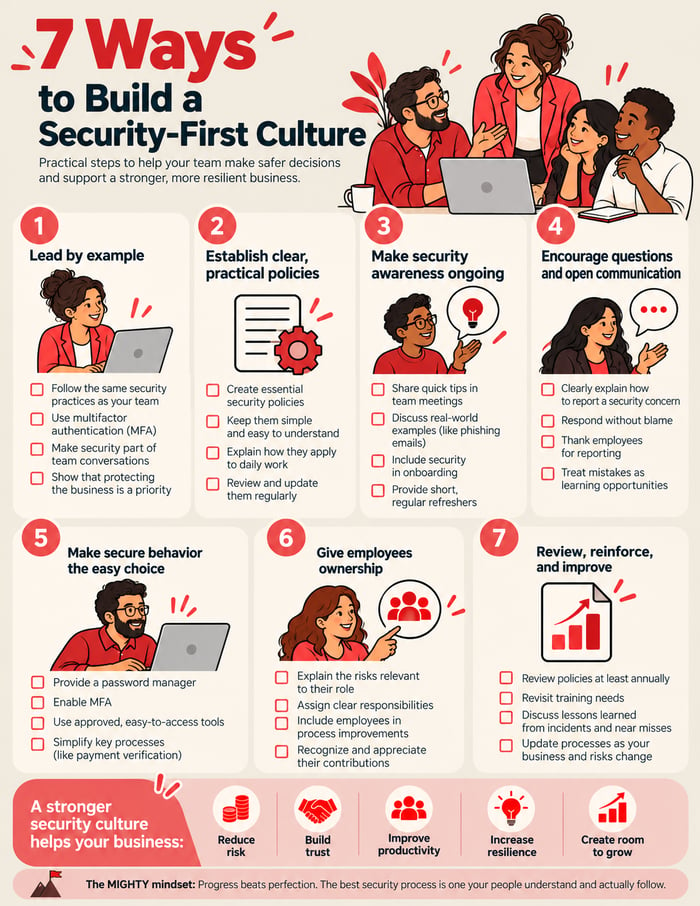
7 practical ways to build a security-first culture
Building a cybersecurity culture doesn't require a complete overhaul of your business.
The goal isn't to eliminate every risk. It's to recognize risks, make informed decisions, and respond effectively.
The goal isn't to eliminate every risk. It's to build a business that can recognize risks, make informed decisions, and respond effectively when something goes wrong.
Start with a few practical improvements, make them part of your routine, and build from there.
1. Lead by example
A security-first culture starts with leadership.
When business owners and managers follow security procedures, take training seriously, and make time to discuss risks, employees are more likely to do the same.
On the other hand, when leaders regularly bypass security controls because they're inconvenient, employees may assume those controls aren't important.
You don't have to know everything about cybersecurity to lead effectively.
You simply need to demonstrate that protecting the business is a shared priority.
Your Action Items
> > Use multifactor authentication on your own business accounts.
> >Follow the same security policies as everyone else.
> >Include cybersecurity in occasional team meetings.
> >Make time and resources available for security improvements.
> >Explain why security matters to your business and customers.
2. Establish clear, practical security policies
Employees can't consistently follow expectations they don't understand.
Security policies establish the basic rules for protecting business information, using technology responsibly, and responding to potential problems. In other words, security policies help you build your culture, right from the start.
But policies only work when people can understand and apply them.
A 40-page document filled with technical terminology might satisfy a documentation requirement, but it probably won't help an employee decide what to do with a suspicious email.
Start with policies that address your most important risks.
Acceptable Use Policy: Defines appropriate use of company devices, accounts, networks, and systems.
AI Acceptable Use Policy: Explains how employees can use AI tools responsibly without exposing sensitive information.
Incident Response Plan:Identifies what employees should do when they suspect a cybersecurity incident.
Your Action Items
Make policies easy to find, use straightforward language, explain expectations during onboarding and when you hold quarterly town hall meetins, and review them whenever your business or technology changes.
Most importantly, make sure employees know what the policies mean for their daily work.
It's not just about documentation.
It's about turning expectations into everyday actions.
A security policy doesn't protect your business simply because it exists. Its value comes from helping employees understand their responsibilities and make better decisions when real situations arise.
The best security policies are clear, actionable, and built around your business's needs. They explain what employees should do, why it matters, and where to turn when they need help.
When policies become part of onboarding, training, and everyday operations, they stop being documents that collect dust and start becoming tools that protect your business.
3. Make security awareness an ongoing conversation
Cybersecurity awareness training is important, but a single annual training session isn't enough to build lasting habits.
Threats evolve, employees forget information, and new situations create new risks.
Instead of relying entirely on formal training, look for opportunities to reinforce security awareness throughout the year.
For example, ask your team:
You receive an urgent email from a familiar vendor asking you to update their banking information. What should you do before making the change?
These discussions can also be expanded into highly practical tabletop exercises, giving employees an opportunity to practice responding to realistic scenarios, identify gaps, and turn lessons learned into actionable improvements for your Security Improvement Roadmap.
Keep the tone practical and supportive.
The goal is to build confidence, not create anxiety.
Your Action Items
> > Share a quick security tip during monthly team meetings.
> >Discuss examples of phishing emails or fraudulent payment requests.
> >Include security expectations in employee onboarding.
> >Provide short refreshers when policies or tools change.
> > Use realistic scenarios to help employees practice making decisions.
4. Make it safe to ask questions and report mistakes
Imagine an employee accidentally clicks a suspicious link.
They're worried they made a mistake, and they're even more worried they'll get in trouble if they tell someone.
So they say nothing.
What might have been a manageable incident now has more time to develop into a serious problem.
A security-first culture depends on employees feeling comfortable speaking up.
That includes reporting suspicious emails, lost devices, unexpected account activity, accidental disclosures, and potential security mistakes.
Employees should understand that reporting a potential security incident quickly is more important than trying to investigate or resolve it themselves.
Your Action Items
> > Explain exactly how employees should report a security concern.
> > Encourage employees to report suspicious activity even when they're uncertain.
> > Respond to good-faith reports without blame or embarrassment.
> > Thank employees for identifying potential problems.
> > Treat mistakes as opportunities to improve training and processes.
At MIGHTY, we like to keep it simple: “Report, then Assess.”
Save and share this motivational poster with your team!
Encourage employees to report suspicious activity immediately, even if they're unsure whether it's a real threat. The right people can then evaluate the situation, determine the risk, and take appropriate action.
A supportive reporting environment means problems are identified and addressed instead of hidden.
A supportive reporting environment doesn't mean eliminating accountability. It means creating conditions where problems are identified and addressed instead of hidden.
5. Make secure behavior the easy choice
Even employees who care about cybersecurity may take shortcuts when security processes are unnecessarily difficult.
If sharing files securely requires ten complicated steps, employees may look for an easier alternative.
If password requirements are difficult to manage, employees may reuse passwords or store them insecurely.
A security-first culture works best when secure behavior fits naturally into everyday workflows.
The objective is to reduce the gap between what employees are supposed to do and what they can realistically accomplish.
Reduce the gap between what employees are supposed to do and what they can realistically accomplish.
Of course, some security measures require extra effort. The key is to make that effort reasonable, explain why it matters, and provide the tools employees need.
Not sure which security practices to prioritize? The Cybersecurity and Infrastructure Security Agency (CISA) offers cybersecurity resources for SMBs to help you establish practical protections without unnecessary complexity.
> > Make approved file-sharing tools easy to access.
> > Establish a simple process for verifying payment changes.
> > Give employees clear instructions for requesting access or technical support.
> > Remove unnecessary steps from security procedures.
6. Give employees ownership of security
Security shouldn't be something that happens only when the IT provider sends an email or management introduces a new rule.
Employees are more likely to engage when they understand how security connects to their responsibilities.
A person handling customer records faces different risks than someone managing invoices, approving payments, or administering business systems.
Tailoring security expectations to these responsibilities makes them more relevant.
For example, your accounting team might help develop a payment verification procedure, while your customer service team helps improve how customer information is handled.
When employees participate in creating practical solutions, security becomes something they help maintain rather than something imposed on them.
Your Action Items
> > Explain the security risks associated with different roles.
> > Assign clear responsibility for important security processes.
> > Include employees when improving workflows that affect their jobs.
> > Encourage team members to suggest practical security improvements.
> > Recognize employees who help identify and reduce risks.
7. Review, reinforce, and improve
Building a cybersecurity culture isn't a one-time project.
Your business changes. Employees join or leave. New software is introduced. Vendors change. Cybersecurity threats evolve.
Your security practices need to evolve, too.
Fortunately, continuous improvement doesn't have to be complicated.
You don't need to address every cybersecurity risk at once.
> > Review important security policies at least annually and after significant changes.
> > Revisit employee training needs throughout the year.
> > Discuss lessons learned from security incidents and near misses.
> > Confirm that employees know how to report concerns.
> > Update procedures when existing processes become confusing or ineffective.
> > Track a few simple measures of progress.
It's not about perfection.
It's about making meaningful progress, one improvement at a time.
A strong security-first culture isn't built overnight, and it doesn't require your business to eliminate every possible risk.
What matters is consistently identifying opportunities to improve, taking action, and building on what you've learned.
Small changes, like simplifying a reporting process or improving how employees verify payment requests, can make a meaningful difference.
Document those improvements in your Security Improvement Roadmap, assign responsibility, and establish realistic timelines. Over time, those actions help your business become more resilient, productive, and confident in managing risk.
Even well-intentioned businesses can struggle to build strong security habits.
Here are a few common mistakes to avoid.
Treating security an IT-only focus
Your IT team or managed service provider (MSP) may manage security technology, but employees throughout the business make decisions that affect security.
A better approach: Make responsibilities clear across the organization while relying on technical experts for appropriate guidance and support.
Creating policies nobody reads
Complicated policies that sit in a folder don't do much to influence behavior.
A better approach: Write policies in plain language, explain how they apply to employees, and make them easy to access.
Relying on annual training alone
One training session rarely creates lasting behavioral change.
A better approach: Reinforce important concepts through short reminders, conversations, onboarding, and realistic examples.
Using fear or blame to motivate
Employees who fear punishment may hesitate to report potential incidents.
A better approach: Encourage early reporting, support learning, and maintain fair accountability.
Expecting perfection
Even well-trained employees make mistakes, and even strong security controls can fail.
A better approach: Combine employee awareness with appropriate technical protections, clear procedures, and incident response planning.
A healthy security culture recognizes that people are an important part of protecting the business, but they shouldn't be the only line of defense.
How do you know if your security culture is improving?
Unlike a software installation or a completed policy document, cybersecurity culture isn't something you can simply mark as finished.
But you can look for signs that employees are becoming more aware, engaged, and consistent in their security practices.
Here are a few useful indicators.
Security-First Culture Indicators
WHAT TO LOOK FOR
WHAT IT MAY TELL YOU
Employees know how to report security concerns
Reporting expectations are clear
Suspicious emails and unusual requests are reported promptly
Employees are recognizing potential threats
Employees can explain policies relevant to their roles
Policies are understood and actionable, not just acknowledged
Security practices are included in onboarding
Expectations are established early
Important security procedures are followed consistently
Security is becoming part of daily operations
Policies and procedures are reviewed regularly
The business is adapting to changing risks
Employees suggest improvements or ask questions
Security is becoming a shared responsibility
What should someone do when something doesn't look right?
Make it clear what should be reported, who should be notified, and how quickly employees should raise a concern.
Keep in mind that no single metric tells the whole story.
For example, an increase in reported suspicious emails might initially seem concerning. But it could also indicate that employees are becoming more comfortable identifying and reporting potential threats.
Look for patterns over time, consider the context, and focus on whether your business is improving its ability to prevent, recognize, and respond to security risks.
Save and share this infographic with your team!
Where should a small business start?
If you're wondering how to build a cybersecurity culture without overwhelming your team, start small.
You don't need to implement all seven recommendations immediately.
Instead, focus on a few foundational actions.
This week: Talk to your team about why cybersecurity matters to your business. Make sure everyone knows how to report suspicious activity or a potential security incident.
This month:Review your most important security policies. Identify where employees may need clearer instructions, better tools, or additional guidance.
This quarter: Introduce a short security awareness activity, address a few priority gaps, and establish a regular process for reviewing and improving your security practices.
As your business becomes more comfortable with these habits, you can introduce additional improvements.
The important thing is to begin building consistency.
The important thing is to begin building consistency that becomes part of normal operations.
A simple process that employees follow every day is often more valuable than an ambitious program that never becomes part of normal operations.
Frequently asked questions about cybersecurity culture
+ What is cybersecurity culture?
Cybersecurity culture refers to the shared attitudes, behaviors, expectations, and practices that influence how people protect information and manage security risks within an organization.
A strong cybersecurity culture encourages employees to recognize risks, follow security procedures, report concerns, and make responsible decisions.
+ How can a small business improve its cybersecurity culture?
Start by establishing clear security policies, setting expectations through leadership, providing practical employee training, encouraging incident reporting, and making secure behavior easier.
Review your progress regularly and prioritize improvements based on your business's risks and resources.
> > You can start by exploring the seven essential policies every small business needs. Read the MIGHTY Guide here.
+ Does every small business need cybersecurity awareness training?
Cybersecurity awareness training is a valuable practice for businesses of all sizes, although specific legal, contractual, or industry requirements vary.
Training should reflect the risks employees encounter in their roles and be reinforced periodically rather than treated as a one-time activity.
Everyone has a role, but leadership is responsible for setting expectations, allocating resources, and establishing accountability.
IT teams and MSPs can provide technical expertise, while managers and employees help put security practices into action.
+ How long does it take to build a security-first culture?
There's no fixed timeline.
A business can begin improving security habits immediately, but developing consistent behaviors takes ongoing reinforcement.
The goal isn't to complete a culture-building project. It's to make cybersecurity a natural part of how your business operates.
+ Can security policies help create a cybersecurity culture?
Yes. Clear, practical policies help employees understand expectations and make consistent decisions.
However, policies are most effective when they're communicated, supported by appropriate tools and training, and reinforced through everyday business practices.
Building a security-first culture starts with small steps
A security-first culture isn't built through fear, complicated rules, or expensive technology alone.
It's built through everyday decisions.
It's the employee who verifies an unusual payment request. The manager who follows the same security procedures as the rest of the team. The business owner who makes time to review policies. And the team member who feels comfortable reporting a potential mistake.
Individually, these actions may seem small.
Together, they help create a business that is more aware, more resilient, and better prepared to manage risk.
And that's what building a security-first culture is really about.
Helping people make confident decisions that protect the business and support its growth.
Make security policies part of your everyday business
Clear policies are one of the foundations of a strong security-first culture.
But creating, maintaining, and reviewing them shouldn't require hours of complicated paperwork.
Not sure where to start?
The Mighty Guide to SMB Policies
Get your free MIGHTY Guide to writing your essential small business policies, and take the first steps toward building a practical policy program that includes InfoSec, Acceptable Use, AI, Business Continuity, Incident Response, Security Improvement Roadmapping, and more.
Start with actionable policies. Build a stronger business.
PolicyPilot by MIGHTY GRC helps small businesses turn complex policy requirements into clear, tailored policies built around how their business actually operates.
Because policies shouldn't just collect dust. They should help people make better decisions.
Explore PolicyPilot and discover a simpler approach to small business policy management.
Your policies should be simple. They should be actionable.
And they should actually get used.
Explore PolicyPilot today and start building policies in minutes.
Thank you from the MIGHTY team. We are dedicated to offering learning resources for small and midsized businesses that are supportive, actionable, and will actually get used.
This article is provided for educational and informational purposes only. It is intended to help small businesses better understand governance, risk, compliance, and policy management, but it is not legal, financial, cybersecurity, insurance, or other professional advice.
Use this content as a starting point for building a stronger, more resilient business—not as a substitute for professional advice tailored to your specific needs.



 You don't need a dedicated cybersecurity team, an enterprise-sized budget, or complicated processes to get started.


 Many cybersecurity incidents involve human actions, including
 Customers, employees, and business partners trust you to handle their information responsibly.
 Cybersecurity incidents can disrupt operations, delay customer service, create unexpected expenses, and damage relationships.
 Cyber insurers, customers, and business partners may ask about your security practices, including employee training, access controls, incident response, and written policies.
 As your business adds employees, technology, vendors, and customers, its security risks change.
 A security-first culture starts with leadership.

 Employees can't consistently follow expectations they don't understand.
 Cybersecurity awareness training is important, but a single annual training session isn't enough to build lasting habits.
 Imagine an employee accidentally clicks a suspicious link.

 Even employees who care about cybersecurity may take shortcuts when security processes are unnecessarily difficult.
 Security shouldn't be something that happens only when the IT provider sends an email or management introduces a new rule.
 Building a cybersecurity culture isn't a one-time project.